1. Understanding 5-HTP – What It Is and How It Works
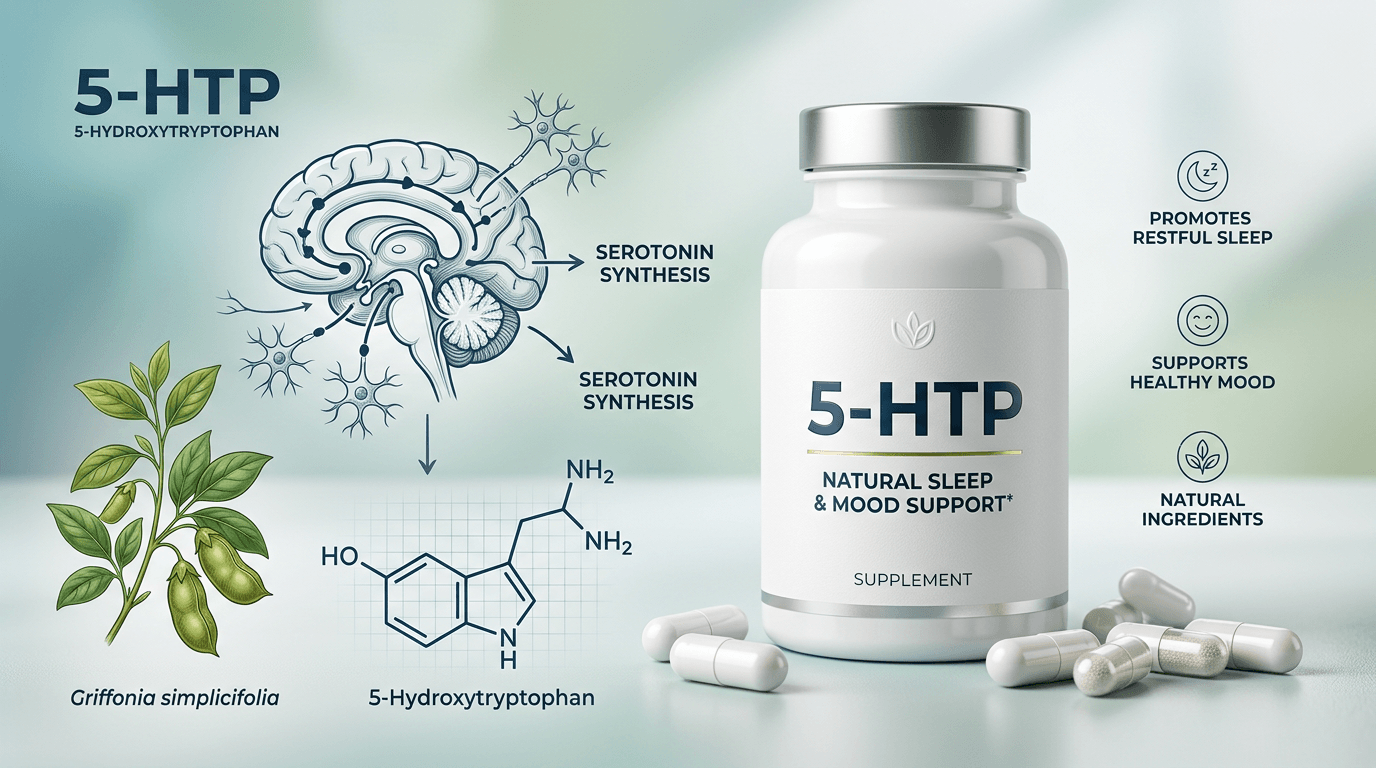
5-Hydroxytryptophan (5-HTP) is an amino acid your body naturally produces as an intermediate step in the synthesis of serotonin. It is not typically found in significant amounts in food, but is commonly taken as a supplement, usually extracted from the seeds of the African plant Griffonia simplicifolia.
How 5-HTP Works in the Body
5-HTP sits in the middle of the serotonin production pathway:
- Tryptophan → 5-HTP → Serotonin (5-HT)
- The enzyme tryptophan hydroxylase converts the amino acid tryptophan into 5-HTP.
- The enzyme aromatic L-amino acid decarboxylase (AADC) then converts 5-HTP into serotonin.
Key points about its mechanism:
- Direct serotonin precursor: Unlike tryptophan, 5-HTP is one metabolic step closer to serotonin, so it bypasses the rate-limiting step (tryptophan hydroxylase).
- Crosses the blood–brain barrier: 5-HTP is transported into the brain, where it can be converted into serotonin in neurons.
- Not strongly limited by diet or competing amino acids: Tryptophan competes with other amino acids for uptake into the brain; 5-HTP is less affected by this competition.
- Can also increase melatonin: In the pineal gland, serotonin can be further converted into melatonin, influencing sleep–wake cycles.
Because of this, 5-HTP is used as a dietary supplement to support:
- Mood and emotional well-being
- Sleep quality
- Appetite regulation and weight management
- Some pain conditions linked to low serotonin (e.g., fibromyalgia, migraine)
However, its ability to raise serotonin also means it must be used cautiously, especially with other serotonergic drugs.
2. Key Benefits of 5-HTP
2.1 Mood Support and Depressive Symptoms
5-HTP is most commonly used for mood because serotonin is central to emotional regulation. Some clinical trials suggest it can reduce depressive symptoms, particularly mild to moderate depression, often at higher doses and sometimes alongside other treatments.
Mechanism: Increased central serotonin availability may enhance mood, reduce irritability, and improve emotional resilience.
2.2 Sleep Quality and Insomnia
By increasing serotonin and downstream melatonin, 5-HTP may help:
- Reduce sleep latency (time to fall asleep)
- Improve sleep depth and REM sleep balance
- Support circadian rhythm indirectly via melatonin
2.3 Appetite Control and Weight Management
Serotonin influences satiety and carbohydrate cravings. 5-HTP may:
- Reduce appetite and spontaneous caloric intake
- Decrease carbohydrate cravings
- Support weight loss when combined with dietary changes
2.4 Pain and Neurological Conditions (Fibromyalgia, Migraine)
Some older but noteworthy studies suggest 5-HTP may help:
- Reduce pain, fatigue, and tender points in fibromyalgia
- Lower migraine frequency and intensity
Evidence is mixed and often based on small, older trials, so this is a potential but not definitive area of benefit.
3. Research Findings on 5-HTP
Below are selected human studies that illustrate what is known about 5-HTP. Note that many trials are small, older, or methodologically limited.
3.1 5-HTP and Depression
Study 1 – 5-HTP vs. fluvoxamine (SSRI)
- Design: Double-blind, randomized trial
- Sample: 63 patients with depression
- Intervention: 5-HTP 100 mg three times daily (300 mg/day) vs. fluvoxamine 50 mg three times daily, for 6 weeks
- Findings: Both groups showed significant improvements on depression rating scales. 5-HTP was reported to be similarly effective to fluvoxamine in this small sample, with somewhat fewer side effects in the 5-HTP group.
- Limitations: Small sample, short duration, older diagnostic criteria; not representative of all depressive disorders.
Study 2 – Augmentation of antidepressants
- Several small open-label studies have explored adding 5-HTP (often 100–300 mg/day) to existing antidepressant regimens. Some report enhanced antidepressant response, but:
- Lack of placebo control
- Small sample sizes
- Increased risk of serotonin syndrome when combined with SSRIs, SNRIs, MAOIs, or other serotonergic drugs
Takeaway: There is suggestive evidence that 5-HTP can improve depressive symptoms, but high-quality, large, modern RCTs are limited. It should never be combined with serotonergic medications without medical supervision.
3.2 5-HTP and Sleep
Study – 5-HTP and sleep architecture
- Design: Small crossover trial in adults with sleep issues
- Sample: ~18–20 participants (varies by report)
- Intervention: 5-HTP doses ranging from 100–300 mg before bedtime
- Findings: Some participants showed:
- Reduced time to fall asleep
- Increased REM sleep proportion
- Fewer nighttime awakenings
- Limitations: Small sample, older polysomnography methods, not consistently replicated.
Combination products: Several commercial sleep formulas combine 5-HTP (50–200 mg) with GABA, melatonin, or herbs (e.g., valerian). Trials on these blends sometimes show improved sleep quality, but the contribution of 5-HTP alone is hard to isolate.
3.3 5-HTP, Appetite, and Weight Loss
Study 1 – Overweight women and spontaneous intake
- Design: Double-blind, placebo-controlled trial
- Sample: 20 overweight but otherwise healthy women
- Intervention: 5-HTP 8 mg/kg/day (roughly 400–500 mg/day for many participants), divided before meals, for 5 weeks
- Findings:
- Significant reduction in spontaneous caloric intake
- Greater weight loss in the 5-HTP group vs. placebo
- Reduced carbohydrate cravings reported
- Limitations: Small sample, short duration, all female.
Study 2 – Obese individuals with dietary guidance
- Design: Double-blind, placebo-controlled trial
- Sample: 19 obese adults
- Intervention: 5-HTP 900 mg/day (300 mg before each meal) vs. placebo for 12 weeks, with dietary counseling
- Findings:
- 5-HTP group had significantly greater weight loss
- Decreased carbohydrate intake and earlier satiety
- Limitations: Small sample; high dose may not be suitable for everyone.
Takeaway: Multiple small RCTs suggest 5-HTP can reduce appetite and support weight loss, particularly by reducing carbohydrate cravings. Long-term safety and efficacy at higher doses remain less clear.
3.4 5-HTP and Fibromyalgia
Study – 5-HTP in fibromyalgia
- Design: Double-blind, placebo-controlled trial
- Sample: 50 patients with primary fibromyalgia
- Intervention: 5-HTP 100 mg three times daily (300 mg/day) vs. placebo for 30 days
- Findings: Compared with placebo, 5-HTP group showed significant improvements in:
- Pain
- Morning stiffness
- Anxiety
- Fatigue
- Number of tender points
- Side effects: Mild gastrointestinal symptoms (nausea, diarrhea) in some participants.
- Limitations: Short duration (1 month); no long-term follow-up.
3.5 5-HTP and Migraine
Several older studies evaluated 5-HTP for migraine prevention.
Example study:
- Design: Randomized, double-blind trial
- Sample: ~60 adults with recurrent migraines
- Intervention: 5-HTP 400–600 mg/day vs. placebo or standard migraine prophylactic drugs over several months
- Findings:
- Reduced migraine frequency and intensity in some trials
- In certain studies, 5-HTP showed similar efficacy to older prophylactic medications but with different side-effect profiles
- Limitations: Older diagnostic criteria, variable dosing, often small samples.
Overall evidence quality: Mixed and based largely on older, small trials. 5-HTP may be helpful for some individuals with migraine or fibromyalgia, but it is not considered a first-line mainstream treatment.
4. Best Sources & Dosage – Forms, Dosing, Timing, Safety
4.1 Common Supplement Forms
- Capsules/Tablets: Most common; typically 50 mg or 100 mg per capsule.
- Extract source: Usually standardized extract from Griffonia simplicifolia seeds.
- Standalone vs. combination products:
- Standalone 5-HTP for targeted dosing.
- Combination formulas with vitamins (B6), magnesium, GABA, melatonin, or herbs.
4.2 General Dosage Guidelines
There is no official RDA for 5-HTP. The following are common clinical and supplemental ranges used in studies and practice, for adults:
For Mood Support / Depressive Symptoms
- Typical range: 100–300 mg/day, divided into 2–3 doses
- Common protocol:
- Start at 50–100 mg once daily with food for 3–7 days
- Gradually increase to 50–100 mg two or three times daily if tolerated (max commonly 300 mg/day without medical supervision)
- Onset: May take 2–4 weeks to notice mood effects, similar to antidepressants.
- Medical supervision strongly recommended, especially if you have a psychiatric diagnosis or are on any psychiatric medication.
For Sleep Support
- Typical range: 50–200 mg taken 30–60 minutes before bedtime
- Some individuals also take a small daytime dose (50–100 mg) and a larger evening dose, but this increases total daily exposure.
For Appetite Control / Weight Management
- Typical range in studies: 300–900 mg/day, divided before meals
- Example: 100–300 mg 30–60 minutes before each main meal
- Practical approach:
- Start low (50–100 mg before 1–2 meals) to assess tolerance
- Increase gradually only if needed and tolerated
For Fibromyalgia or Migraine (Under Medical Supervision)
- Study-based range: 300–600 mg/day, divided into 2–3 doses
- These higher doses should be supervised by a clinician due to increased side-effect and interaction risk.
4.3 Timing and Administration Tips
- With or without food?
- Can be taken with food to reduce nausea.
- For weight/appetite effects, taking before meals is typical.
- For sleep, take on an empty or light stomach 30–60 minutes before bed.
- Titration: Always start at the lower end of the range and increase slowly.
- Cycling: Some practitioners recommend periodic breaks (e.g., 5 days on / 2 days off, or several weeks on / 1 week off) to reduce tolerance risk, though robust data on tolerance are limited.
4.4 Safety, Side Effects, and Interactions
Common Side Effects
Most side effects are dose-dependent and often gastrointestinal:
- Nausea
- Diarrhea or loose stools
- Abdominal discomfort or cramping
- Heartburn
- Headache
- Drowsiness or, less commonly, agitation/restlessness
Reducing the dose, taking with food, or splitting doses can help.
Serious Risks
Serotonin Syndrome
- A potentially life-threatening condition caused by excessive serotonin.
- Symptoms can include:
- Agitation, confusion
- Rapid heart rate, high blood pressure
- Sweating, shivering, fever
- Muscle rigidity, tremor, clonus
- Risk is highest when 5-HTP is combined with other serotonergic agents.
Eosinophilia–Myalgia Syndrome (EMS)
- In the late 1980s, EMS was linked to contaminated L-tryptophan supplements, not clearly to 5-HTP.
- A few case reports have suggested a possible link between contaminated 5-HTP and EMS-like illness, but this remains rare and controversial.
- Emphasizes the importance of high-quality, third-party-tested products.
Potential Heart Valve Concerns (Theoretical)
- Excessive serotonin in the periphery has been linked to valvular heart disease (e.g., in carcinoid syndrome or with certain older drugs).
- It is unclear whether typical 5-HTP doses significantly raise peripheral serotonin enough to pose this risk, but it is a theoretical concern at high doses or long-term use.
Drug and Supplement Interactions
Avoid combining 5-HTP with the following unless specifically directed and monitored by a physician:
- SSRIs (e.g., fluoxetine, sertraline, citalopram)
- SNRIs (e.g., venlafaxine, duloxetine)
- MAOIs (e.g., phenelzine, tranylcypromine)
- Tricyclic antidepressants (e.g., amitriptyline, clomipramine)
- Other serotonergic agents, including:
- Tramadol
- Certain migraine drugs (triptans like sumatriptan)
- Linezolid
- Dextromethorphan (high doses)
- Lithium
- St. John’s wort
- MDMA, LSD, and other serotonergic recreational drugs
Combination can significantly increase the risk of serotonin syndrome.
Other interactions/considerations:
- Carbidopa (for Parkinson’s disease): Combining carbidopa with 5-HTP may increase the risk of gastrointestinal and other side effects due to altered peripheral metabolism.
- Sedatives and CNS depressants: 5-HTP may increase drowsiness when combined with alcohol, benzodiazepines, sedative antihistamines, or sleep medications.
4.5 Who Should and Should Not Use 5-HTP
Potential Candidates (With Appropriate Guidance)
- Adults with:
- Mild mood disturbances, low mood, or seasonal affective tendencies (after medical evaluation)
- Difficulty falling asleep or staying asleep
- Strong carbohydrate cravings or difficulty controlling appetite
- Fibromyalgia or recurrent migraine, when standard treatments are inadequate and under specialist supervision
People Who Should Avoid 5-HTP (or Use Only Under Specialist Care)
- Children and adolescents: Safety data are limited; use only under pediatric specialist guidance.
- Pregnant or breastfeeding individuals: Insufficient safety data; generally not recommended.
- People taking any serotonergic medication, including:
- Antidepressants (SSRIs, SNRIs, MAOIs, TCAs)
- Triptans, tramadol, certain opioids
- St. John’s wort or other serotonergic supplements
- Individuals with bipolar disorder: Increasing serotonin may trigger mania or hypomania in susceptible individuals.
- People with significant cardiovascular disease: Theoretical concerns about peripheral serotonin and blood pressure/heart valves at high doses; consult a cardiologist.
- Those with chronic gastrointestinal disease: Nausea and diarrhea may worsen underlying conditions.
- Individuals with kidney or liver impairment: Reduced clearance can increase risk; medical supervision is advised.
4.6 Practical Safety Checklist
Before considering 5-HTP:
- Consult a healthcare professional if you:
- Have a diagnosed mental health condition
- Take any prescription or over-the-counter medications
- Are pregnant, breastfeeding, or planning pregnancy
- Start low and go slow: Begin at the lowest effective dose and titrate gradually.
- Monitor for side effects: Especially mood changes, agitation, GI issues, or unusual symptoms.
- Stop use and seek medical help immediately if you experience symptoms suggestive of serotonin syndrome (agitation, confusion, fever, rapid heartbeat, muscle rigidity, severe restlessness).
- Choose reputable brands: Look for third-party testing (e.g., USP, NSF, Informed-Choice) to minimize contamination risk.
Summary
5-HTP is a naturally occurring intermediate in serotonin synthesis and a widely used dietary supplement for mood, sleep, appetite control, and certain pain conditions. Evidence from small clinical trials suggests potential benefits for:
- Mild to moderate depressive symptoms
- Sleep initiation and quality
- Appetite suppression and weight loss
- Fibromyalgia and migraine in some individuals
However, the research base is limited by small sample sizes, short durations, and older study designs. 5-HTP is not a substitute for professional mental health care or prescribed treatments.
Appropriate dosing typically ranges from 50–300 mg/day for mood and sleep, with higher doses (up to 900 mg/day) used short-term in some weight-loss or pain studies under medical supervision. Side effects are usually gastrointestinal and dose-related, but the major concern is serotonin syndrome, especially when combined with other serotonergic drugs.
Used thoughtfully—with medical guidance, careful dosing, and attention to interactions—5-HTP can be a useful tool in a broader strategy for supporting mood, sleep, and appetite. It is not appropriate for everyone, particularly those on psychiatric medications, pregnant or breastfeeding individuals, and people with certain medical conditions.