1. Understanding 5-HTP – What It Is and How It Works
What is 5-HTP?
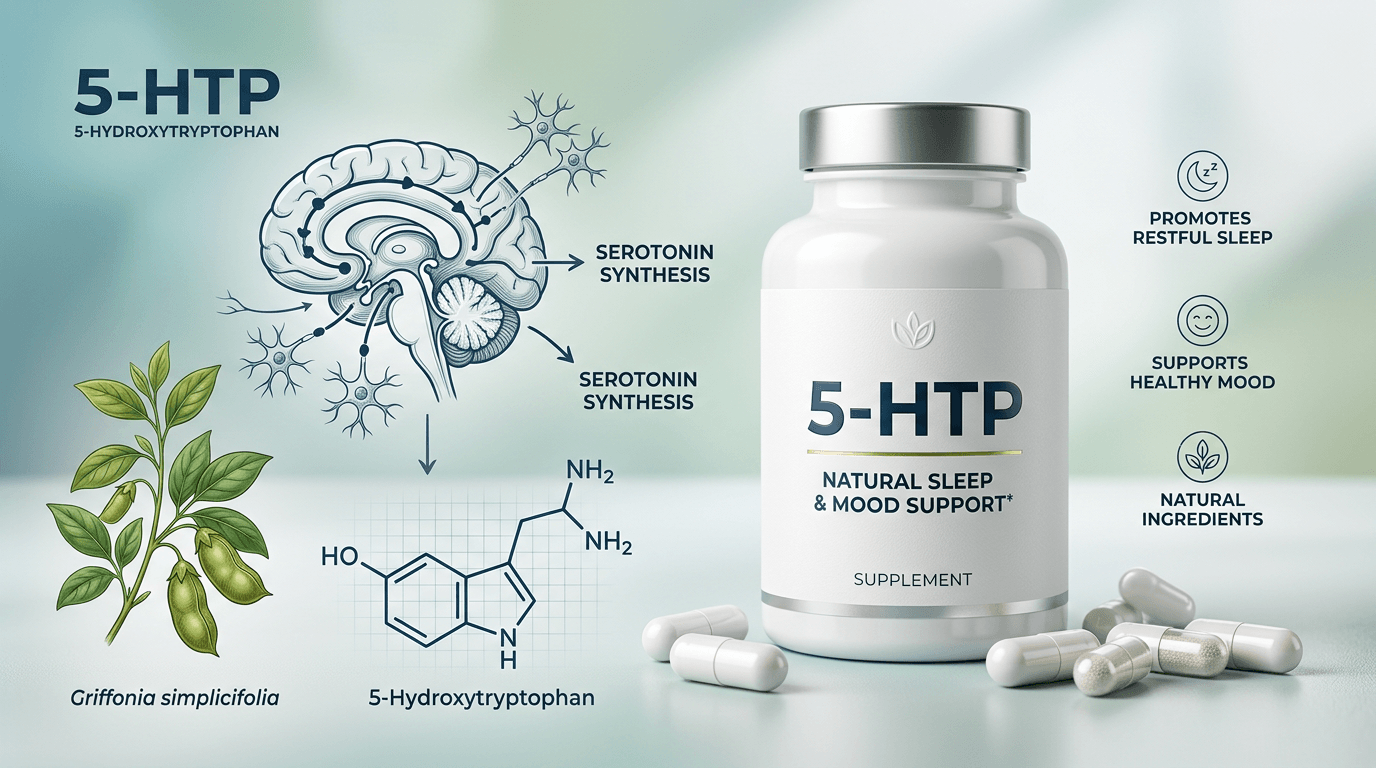
5-HTP (5-hydroxytryptophan) is an amino acid that the body naturally produces from L-tryptophan, an essential amino acid found in protein-rich foods. It is the direct precursor to serotonin, a neurotransmitter involved in mood, appetite, pain perception, and sleep regulation.
As a dietary supplement, 5-HTP is typically extracted from the seeds of the African plant Griffonia simplicifolia. Unlike tryptophan, which competes with other amino acids for transport across the blood–brain barrier, 5-HTP is more efficiently converted to serotonin in the central nervous system.
How 5-HTP Works in the Body
Biochemical pathway
- Dietary protein → L-tryptophan
- L-tryptophan → 5-HTP (via tryptophan hydroxylase)
- 5-HTP → serotonin (5-HT) (via aromatic L-amino acid decarboxylase)
- In the pineal gland, serotonin → melatonin (sleep hormone)
Crossing the blood–brain barrier
- 5-HTP is transported into the brain via a neutral amino acid transporter.
- Once in the brain, it is converted to serotonin, increasing central serotonin levels more directly than tryptophan.
Why it’s used as a supplement
- Serotonergic signaling is involved in mood, anxiety, appetite, and sleep regulation.
- By increasing serotonin synthesis, 5-HTP may support these functions.
Important Mechanistic Considerations
- Non-selective serotonin increase: 5-HTP does not target specific brain regions; it can increase serotonin broadly, which is why it may help in multiple domains but also carries risks (e.g., serotonin syndrome when combined with other serotonergic drugs).
- Peripheral vs central conversion: Some 5-HTP is converted to serotonin outside the brain (e.g., in the gut), which can contribute to gastrointestinal side effects. Co-administration with a peripheral decarboxylase inhibitor (like carbidopa in some research settings) alters this, but such combinations are not standard for over-the-counter use.
2. Key Benefits of 5-HTP
1. Mood Support and Depressive Symptoms
By increasing serotonin availability, 5-HTP has been studied as an adjunct or alternative to antidepressant medications. Some trials show antidepressant-like effects, particularly in mild-to-moderate depression, though evidence is still limited compared with standard antidepressants.
2. Sleep Quality and Insomnia
Because serotonin is a precursor to melatonin, 5-HTP may improve sleep onset and sleep quality. Some studies suggest it can increase REM sleep and reduce sleep latency when used alone or with other sleep-related nutrients.
3. Appetite Control and Weight Management
Serotonin modulates satiety and carbohydrate cravings. 5-HTP has been found in several trials to reduce caloric intake, particularly from carbohydrates, and support modest weight loss in overweight individuals.
4. Migraine and Tension-Type Headaches (Preliminary)
5-HTP has been investigated as a prophylactic (preventive) agent for migraines and some tension-type headaches, with mixed but sometimes promising results, especially in older studies.
3. Research Findings on 5-HTP
3.1 Depression and Mood
Meta-analytic evidence
- A 2002 review and meta-analysis of tryptophan and 5-HTP (Shaw et al., Cochrane Database) examined randomized controlled trials (RCTs) for depression. The authors concluded that there was some evidence of benefit over placebo but emphasized that the number of high-quality studies was small and sample sizes were limited (many trials had fewer than 50 participants). They called for larger, well-designed RCTs.
Individual trials
5-HTP vs. fluvoxamine (SSRI): In a double-blind study (Poldinger et al., 1991), 63 patients with depression were randomized to receive either 5-HTP (100 mg three times daily) or fluvoxamine (an SSRI, 50 mg three times daily) for 6 weeks. Both treatments produced significant improvements on depression rating scales, and 5-HTP was reported to be comparable in efficacy, with somewhat fewer side effects. However, this was a single, relatively small trial and may not generalize to all patient populations.
Adjunctive use: Some small open-label or uncontrolled studies suggest that 5-HTP may enhance the effects of antidepressants, but combining 5-HTP with SSRIs/SNRIs or MAOIs carries a significant risk of serotonin syndrome and is not recommended outside of carefully supervised research or specialist care.
Takeaway: Evidence suggests 5-HTP can improve depressive symptoms, but the research base is modest compared with conventional antidepressants. It should not be considered a direct replacement for prescribed treatment without medical supervision.
3.2 Anxiety
Research on 5-HTP specifically for anxiety disorders is limited. Some studies in healthy volunteers show that 5-HTP can influence brain activity and emotional processing in ways consistent with anxiolytic (anti-anxiety) effects, but robust clinical trials in generalized anxiety or panic disorder are lacking.
One small study (n≈15–20, acute design) in healthy subjects suggested that 5-HTP (200 mg single dose) could reduce panic-like responses to a laboratory challenge, but this is far from conclusive clinical evidence.
Takeaway: Anxiety-related benefits are plausible based on serotonin’s role and preliminary data, but 5-HTP should not be relied upon as a primary treatment for anxiety disorders.
3.3 Sleep and Insomnia
5-HTP and sleep architecture: Early sleep studies (1970s–1990s, typically n=10–30 participants) reported that 5-HTP (100–300 mg at night) increased REM sleep and improved subjective sleep quality. These often used polysomnography and showed changes in REM latency and REM duration. However, many of these studies are older and not always up to modern trial standards.
Combination formulas: A more recent randomized, double-blind, placebo-controlled trial (Maffei et al., 2012; n=45) evaluated a combination product containing 5-HTP (100 mg) plus GABA and other cofactors in individuals with sleep disturbances over 4 weeks. The active group reported improved sleep latency and quality versus placebo. Because this was a multi-ingredient product, the specific contribution of 5-HTP cannot be isolated.
Takeaway: 5-HTP appears to support sleep onset and REM sleep, especially when taken in the evening, but high-quality, modern, 5-HTP-only trials are relatively sparse.
3.4 Appetite, Cravings, and Weight Loss
Overweight women and carbohydrate intake: A double-blind, placebo-controlled trial (Ceci et al., 1989; n=19 overweight women) used 5-HTP at 8 mg/kg/day (~400–500 mg/day for many participants) for 5 weeks. Results:
- Significant reduction in daily caloric intake (especially carbohydrates) in the 5-HTP group.
- Average weight loss of about 1.5–2.0 kg over 5 weeks compared to minimal change in the placebo group.
Longer-term study: Another study (Cangiano et al., 1992; n=20 obese subjects) used 900 mg/day 5-HTP (300 mg three times daily) for 12 weeks. Findings:
- Reduced appetite and spontaneous caloric intake.
- Greater weight loss in the 5-HTP group compared with placebo.
Takeaway: Several small RCTs suggest that 5-HTP can reduce appetite and support modest weight loss, particularly by decreasing carbohydrate cravings. However, sample sizes are small, and long-term safety and efficacy data are limited.
3.5 Migraines and Headaches
Migraine prophylaxis: A double-blind trial (Sicuteri et al., late 1970s; n≈60) compared 5-HTP (600 mg/day) with methysergide (a migraine prophylactic drug) over several months in migraine patients. Both groups experienced reductions in migraine frequency and intensity, with 5-HTP performing similarly to methysergide in some measures, but with fewer side effects.
Other small studies (n=20–60) have reported reduced migraine frequency with 5-HTP doses of 300–600 mg/day. However, results are mixed, and some trials did not find significant benefit over placebo.
Takeaway: 5-HTP may help reduce migraine frequency and severity in some people, but evidence is inconsistent and largely from older studies.
4. Best Sources & Dosage – Forms, Dosing, Timing, Safety
Sources and Forms of 5-HTP
- Primary supplemental source: Extracted from Griffonia simplicifolia seeds.
- Common forms:
- Capsules or tablets (most common)
- Standalone 5-HTP or combination formulas (e.g., with GABA, magnesium, B6, or melatonin)
- Typical strengths: 50 mg, 100 mg, and 200 mg capsules.
General Dosing Principles
- Start with the lowest effective dose and titrate slowly.
- Take with or without food depending on tolerance. Some people find taking with a small snack reduces nausea.
- Because 5-HTP can cause drowsiness in some users, evening dosing is common, especially for sleep-related goals.
Common Use Cases and Dosage Ranges
1. Mood Support / Mild Depressive Symptoms
- Typical range: 100–300 mg/day
- Common protocol:
- Start: 50–100 mg once daily (often in the evening) for 1 week.
- If tolerated and needed, increase to 100 mg twice daily (morning and evening).
- Maximum common supplemental dose: 300 mg/day, divided into 2–3 doses.
- Onset: Some individuals notice effects within days, but mood benefits may take 2–4 weeks.
2. Sleep and Insomnia
- Typical range: 50–200 mg taken 30–60 minutes before bedtime.
- Protocol:
- Start with 50 mg at night.
- Gradually increase to 100–150 mg if needed.
- Some individuals may use up to 200 mg, but higher doses increase the risk of side effects.
3. Appetite Control / Weight Management
- Typical range in studies: 300–900 mg/day, divided doses.
- Practical approach:
- Start with 50–100 mg, 30–60 minutes before meals (1–3 times daily).
- Research doses (e.g., 300 mg three times daily) are relatively high and should be approached cautiously under professional supervision.
4. Migraine Prophylaxis
- Research doses: 300–600 mg/day, divided into 2–3 doses.
- Due to mixed evidence and the need for medical evaluation of recurrent headaches, this use should be supervised by a healthcare professional.
Duration of Use
- Many clinical trials last 4–12 weeks.
- For long-term use beyond 3 months, periodic breaks (e.g., 1–2 weeks off every few months) and medical monitoring are prudent, especially at higher doses.
Practical Tips for Use
- Timing:
- For mood: split dosing (morning + evening) can provide more stable effects.
- For sleep: primary dose in the evening.
- With food vs. empty stomach:
- Absorption may be better on an empty stomach, but GI side effects are more likely.
- Many users take it with a light snack to balance absorption and tolerability.
5. Safety, Side Effects, and Drug Interactions
Common Side Effects
Side effects are often dose-dependent and more likely at ≥200–300 mg/day.
- Gastrointestinal:
- Nausea
- Diarrhea or loose stools
- Abdominal discomfort
- Neurological/psychological:
- Drowsiness or fatigue
- Headache
- Vivid dreams or nightmares
- Occasionally agitation or restlessness
- Others:
- Heartburn
- Mild palpitations in sensitive individuals
These effects often improve by lowering the dose, taking with food, or splitting the daily dose.
Serious Risks
1. Serotonin Syndrome (Major Concern)
Serotonin syndrome is a potentially life-threatening condition caused by excessive serotonergic activity in the central nervous system.
Risk factors with 5-HTP:
- Combining 5-HTP with other serotonergic drugs or supplements, especially:
- SSRIs (e.g., fluoxetine, sertraline, citalopram)
- SNRIs (e.g., venlafaxine, duloxetine)
- MAOIs (e.g., phenelzine, tranylcypromine)
- Tricyclic antidepressants (e.g., amitriptyline, clomipramine)
- Certain pain medications (e.g., tramadol, meperidine)
- Some anti-migraine drugs (triptans like sumatriptan)
- Linezolid and other MAOI-like antibiotics
- St. John’s wort and other serotonergic herbs/supplements
Symptoms of serotonin syndrome (seek emergency care immediately):
- Mental status changes: agitation, confusion
- Autonomic instability: rapid heart rate, high blood pressure, sweating, fever
- Neuromuscular abnormalities: tremor, muscle rigidity, clonus, incoordination
- Gastrointestinal: diarrhea
Because of this risk, 5-HTP should generally not be combined with prescription antidepressants or other serotonergic agents unless explicitly supervised by a physician experienced in such combinations.
2. Eosinophilia-Myalgia Syndrome (EMS) Concerns
EMS is a rare but serious condition that was linked to contaminated L-tryptophan supplements in the late 1980s. There have been a few case reports raising concern about 5-HTP contamination, but large-scale associations are not clearly established.
- The main concern is contaminants, not 5-HTP itself.
- This underscores the importance of choosing high-quality brands with third-party testing.
3. Cardiovascular and Blood Pressure Effects
- Serotonin can influence blood vessel tone and platelet function.
- At typical supplemental doses, major cardiovascular effects are uncommon in healthy individuals, but those with cardiovascular disease or on blood pressure medications should use 5-HTP cautiously and under medical supervision.
Drug and Supplement Interactions
Avoid or use only under medical supervision with:
- Antidepressants:
- SSRIs, SNRIs, MAOIs, tricyclics, atypical antidepressants (e.g., bupropion has minimal serotonergic activity but caution is still advised in combinations).
- Other serotonergic medications:
- Triptans (migraine drugs)
- Certain opioids (tramadol, meperidine)
- Dextromethorphan (common in cough syrups, especially at high doses)
- Linezolid and similar agents
- Serotonergic supplements/herbs:
- St. John’s wort
- SAMe
- High-dose tryptophan
Caution with:
- Sedatives and CNS depressants (benzodiazepines, sleep medications, alcohol): 5-HTP can increase drowsiness.
- Blood pressure medications: monitor blood pressure for unexpected changes.
Special Populations
- Pregnancy and breastfeeding: Safety data are insufficient. 5-HTP is generally not recommended during pregnancy or lactation without explicit medical guidance.
- Children and adolescents: Limited data. 5-HTP has been studied in some pediatric conditions (e.g., certain sleep or behavioral disorders) under specialist supervision, but self-directed use is not recommended.
- Liver or kidney disease: Metabolism and excretion may be altered; use only under medical supervision.
- History of bipolar disorder or mania: Any serotonergic agent, including 5-HTP, may theoretically increase the risk of mood switching to hypomania or mania. Use is generally contraindicated or requires close psychiatric supervision.
6. Who Should and Shouldn’t Use 5-HTP
Who May Consider 5-HTP (With Appropriate Guidance)
- Adults with:
- Mild depressive symptoms who are not on serotonergic medications and have discussed it with a healthcare professional.
- Occasional insomnia or difficulty falling asleep, where behavioral and sleep hygiene measures have been tried first.
- Strong carbohydrate cravings or appetite issues contributing to weight gain, as part of a broader lifestyle program.
- Migraines, under supervision of a clinician familiar with 5-HTP and after ruling out other causes.
In all cases, 5-HTP should complement—not replace—fundamental approaches such as therapy, sleep hygiene, diet, exercise, and medical evaluation when indicated.
Who Should Avoid 5-HTP (Unless Specialist-Supervised)
- Individuals currently taking:
- Any SSRI, SNRI, MAOI, tricyclic antidepressant, or other serotonergic psychiatric medication.
- Triptans for migraine, tramadol, or other serotonergic drugs.
- People with:
- Bipolar disorder, schizoaffective disorder, or a history of mania/hypomania.
- Uncontrolled hypertension or significant cardiovascular disease (without medical oversight).
- Significant liver or kidney impairment (unless cleared by a specialist).
- Pregnant or breastfeeding women due to lack of safety data.
- Children and adolescents, unless under the care of a pediatric specialist.
When to Stop and Seek Medical Advice
Discontinue 5-HTP and consult a healthcare professional if you experience:
- Signs suggestive of serotonin excess: agitation, confusion, rapid heartbeat, high blood pressure, tremor, fever, severe sweating.
- Worsening mood, suicidal thoughts, or new-onset anxiety or agitation.
- Severe gastrointestinal symptoms (persistent vomiting, severe diarrhea) or muscle pain with weakness (possible EMS-like reaction, though rare).
Summary
5-HTP is a serotonin precursor derived mainly from Griffonia simplicifolia that has been studied for mood support, sleep, appetite control, and migraine prevention. Clinical research—including several small RCTs—suggests potential benefits, particularly for mild depressive symptoms, sleep onset, and appetite reduction, though evidence is not as robust as for standard pharmaceutical treatments.
Typical supplemental doses range from 50–300 mg/day, with higher doses (up to 900 mg/day) used in some research for obesity and migraines. Common side effects include nausea, GI discomfort, and drowsiness. The most serious risk is serotonin syndrome, especially when combined with antidepressants or other serotonergic drugs or supplements.
5-HTP may be a reasonable option for some adults seeking a serotonergic dietary supplement, provided they are not on interacting medications and understand the potential risks. Medical consultation is strongly advised before starting 5-HTP, particularly for individuals with mental health conditions, chronic illness, or those taking any prescription medications.