1. Understanding Piracetam – What It Is and How It Works
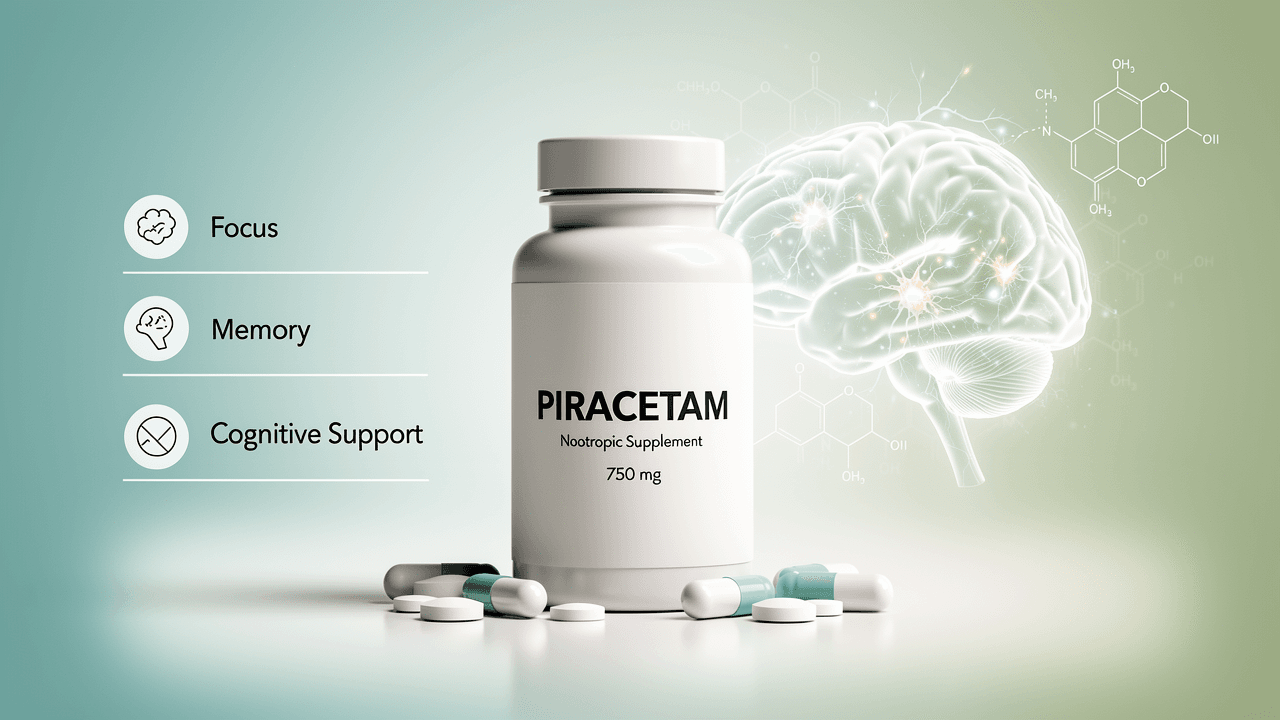
Piracetam is a synthetic compound in the racetam family, first developed in the 1960s by Corneliu Giurgea. It is often described as a "nootropic"—a substance intended to enhance cognitive function with relatively low toxicity.
Although widely used as a cognitive enhancer and prescribed in some countries (mainly Europe) for cognitive impairment, piracetam is not approved as a drug or dietary supplement by the U.S. FDA. In the U.S., it is often sold as a research chemical. Regulatory status varies by country.
1.1 Chemical nature and pharmacology
- Class: Racetam nootropic
- Structure: Cyclic derivative of gamma-aminobutyric acid (GABA), but it does not act like GABA and does not bind typical GABA receptors.
- Bioavailability: Oral bioavailability is high (often cited ~95% in pharmacology references).
- Half-life: Roughly 4–5 hours in healthy adults; longer in older adults or those with kidney impairment.
- Excretion: Primarily unchanged in the urine; minimal metabolism.
1.2 Proposed mechanisms of action
Piracetam’s exact mechanism is not fully understood, but several pathways are supported by experimental data:
Modulation of neuronal membranes and fluidity
- Piracetam appears to increase membrane fluidity in neurons and erythrocytes.
- In vitro and animal studies show improved membrane dynamics, which may enhance receptor function and signal transduction.
Neurotransmitter modulation
Evidence suggests piracetam may:- Enhance cholinergic neurotransmission (especially when acetylcholine is available).
- Modulate glutamatergic (AMPA and NMDA) receptors indirectly.
- Influence dopamine and noradrenaline in certain brain regions.
Improved microcirculation and rheology
- In clinical and laboratory studies, piracetam reduces erythrocyte aggregation and improves red blood cell deformability, potentially enhancing cerebral blood flow, particularly in compromised circulation.
Neuroprotection and mitochondrial function (preclinical)
- Animal and cell studies show protection against hypoxia and certain neurotoxic insults.
- May improve mitochondrial function and reduce oxidative damage, though human evidence is limited.
Overall, piracetam is best characterized as a neuromodulator that may improve neuronal efficiency and communication rather than a classic stimulant.
2. Key Benefits of Piracetam
2.1 Cognitive function in age-related decline and dementia
The most consistent human data for piracetam are in cognitive impairment, dementia, and age-related decline, rather than in healthy young adults.
- Studies in older adults suggest modest improvements in memory, global cognition, and daily functioning, especially in mild to moderate impairment.
- Benefits tend to be small to moderate, and not all trials find significant effects.
2.2 Post-stroke and vascular cognitive impairment
Piracetam has been used in patients with post-stroke cognitive deficits and vascular dementia.
- Some trials report improvements in cognitive scores, language function (aphasia), and functional recovery when combined with standard rehabilitation.
- Effects are not universal and may depend on timing, dose, and severity of impairment.
2.3 Myoclonus and certain movement disorders
Piracetam is approved in some countries (e.g., parts of Europe) for cortical myoclonus, a type of sudden, involuntary muscle jerking.
- Higher doses (often 7.2–24 g/day) are used under medical supervision.
- Evidence supports a significant reduction in myoclonic jerks in some patients.
2.4 Potential cognitive enhancement in healthy people
Evidence for piracetam as a nootropic in healthy, young adults is limited and mixed.
- Some small studies suggest subtle improvements in memory or learning, but results are inconsistent and often methodologically weak.
- Many anecdotal reports describe improved verbal fluency, mental clarity, and reduced brain fog, but these are not a substitute for rigorous clinical data.
Overall, the strongest evidence is in clinical populations (cognitive impairment, myoclonus), not in healthy users.
3. Research Findings
Below are examples of key studies and reviews that illustrate piracetam’s effects.
3.1 Cognitive impairment and dementia
Meta-analysis of piracetam in cognitive impairment (1991)
- Design: Meta-analysis of 19 double-blind, placebo-controlled studies (various etiologies of cognitive impairment).
- Sample size: ~1,000+ patients combined (exact numbers vary by source).
- Duration: Typically 6–12 weeks.
- Findings: Piracetam showed a statistically significant overall benefit on global clinical impression and some cognitive measures compared with placebo. Effects were modest but consistent across many trials.
- Limitations: Many older studies, variable quality, heterogeneous patient populations.
Study in elderly with cognitive impairment
- Design: Double-blind, placebo-controlled.
- Sample: 60–100 elderly patients (numbers differ by specific trial) with age-related cognitive decline or mild dementia.
- Dose: Often 2.4–4.8 g/day, divided into 2–3 doses.
- Duration: 8–12 weeks.
- Outcomes: Some trials reported improvements in memory tests, attention, and clinician-rated global function versus placebo; others showed trends but not always statistical significance.
- Interpretation: Suggests potential benefit, but not a robust, disease-modifying effect.
3.2 Post-stroke and aphasia
Post-stroke aphasia trial
- Design: Randomized, double-blind, placebo-controlled.
- Sample: ~80–120 patients with post-stroke aphasia.
- Dose: 4.8–12 g/day.
- Duration: 6–12 weeks, often alongside speech therapy.
- Findings: Some studies reported improved language recovery (e.g., naming, comprehension scores) in piracetam groups compared with placebo.
- Limitations: Differences in stroke severity, timing of treatment initiation, and outcome measures make direct comparison difficult.
3.3 Cortical myoclonus
Multicenter trial in cortical myoclonus
- Design: Double-blind, placebo-controlled, crossover.
- Sample: ~20–40 patients with severe cortical myoclonus.
- Dose: High doses, often 7.2–24 g/day.
- Duration: Several weeks per treatment phase.
- Findings: Significant reduction in myoclonic jerks and functional improvement in many patients, particularly at higher doses.
- Clinical relevance: Supports piracetam’s use as an adjunct therapy in treatment-resistant cortical myoclonus under specialist care.
3.4 Healthy volunteers and students
Evidence here is limited and often older:
- Small double-blind trials in healthy adults (sample sizes ~16–60) using doses around 2.4–4.8 g/day for several weeks have shown mixed results. Some report modest improvements in verbal learning or memory consolidation; others show no significant effect over placebo.
- Methodological limitations include small sample sizes, short duration, and variable cognitive tests.
Bottom line from research:
- Best evidence: Cognitive impairment, post-stroke deficits, cortical myoclonus.
- Weak/inconclusive evidence: Cognitive enhancement in healthy people.
- Data gaps: Long-term safety and efficacy for off-label nootropic use, especially in younger, healthy populations.
4. Best Sources & Dosage – Forms, Dosing, Timing, and Safety
4.1 Forms and quality considerations
Because piracetam’s regulatory status varies, product quality is highly variable, especially where it is sold as a research chemical.
Common forms:
- Tablets or capsules: Typically 400–800 mg per capsule/tablet.
- Powder: Often used by nootropic users for flexible dosing.
Quality tips:
- Look for third-party testing (e.g., certificates of analysis for purity, heavy metals, and identity).
- Avoid vendors making drug-like disease-treatment claims if the product is marketed as a supplement in jurisdictions where this is not allowed.
- In countries where piracetam is a prescription drug, use should be under medical supervision with pharmacy-grade products.
4.2 Typical dosage ranges
Important: These ranges are based on clinical and anecdotal use; they are not official recommendations, and piracetam is not FDA-approved for any indication in the U.S.
4.2.1 Cognitive impairment / dementia (clinical literature)
- Common clinical doses: 2.4–4.8 g/day, divided into 2–3 doses.
- Some trials use up to 8 g/day.
- Often administered for 8–12 weeks or longer in clinical settings.
4.2.2 Cortical myoclonus (under specialist care)
- High-dose regimens: 7.2–24 g/day, divided into multiple doses.
- Dosing is titrated and closely monitored by a neurologist.
- Not suitable for self-experimentation.
4.2.3 Off-label nootropic use in generally healthy adults (research-chemical context)
This is where evidence is weakest and practice is largely extrapolated from clinical data and user reports.
- Common starting dose: 800–1,600 mg, 2–3 times per day (total 1.6–4.8 g/day).
- Some users report benefits at 1.6–3.2 g/day; others go higher, but increasing dose does not always increase benefit and may increase side effects (e.g., headaches, irritability).
Titration approach (informational, not medical advice):
- Start low (e.g., 800 mg once or twice daily).
- Increase gradually every few days if tolerated, up to 2.4–3.2 g/day.
- Evaluate cognitive and side-effect profile after 2–4 weeks.
4.3 Timing and administration
- Dosing frequency: 2–3 times per day due to ~4–5 hour half-life.
- With or without food: Can be taken with or without food; some report fewer GI side effects with food.
- Choline co-supplementation: Many users and some practitioners suggest pairing piracetam with a choline source (e.g., alpha-GPC, CDP-choline, or dietary choline) to reduce headaches, which may be related to increased cholinergic demand.
4.4 Safety, side effects, and interactions
Piracetam has been used in large numbers of patients for decades and is generally considered to have a low acute toxicity. However, this does not mean it is risk-free, especially with long-term, unsupervised use.
4.4.1 Common side effects
Reported in clinical and user contexts:
- Headache (often cited as the most common complaint in healthy users)
- Insomnia or restlessness (especially if taken late in the day)
- Nervousness, irritability, agitation
- Gastrointestinal issues: nausea, diarrhea, abdominal discomfort
- Dizziness
- Weight gain (reported in some clinical trials, mechanism unclear)
These effects are often dose-related and may improve with dose reduction or cessation.
4.4.2 Serious or rare side effects
Serious adverse events are relatively rare but may include:
- Worsening of epilepsy or seizures in susceptible individuals, particularly with abrupt discontinuation in those using it for myoclonus.
- Bleeding risk: Because piracetam can affect platelet aggregation and blood rheology, there is concern about increased bleeding risk, especially when combined with anticoagulants or antiplatelet drugs.
4.4.3 Drug interactions and cautions
Anticoagulants and antiplatelet drugs
- Examples: warfarin, heparin, DOACs (apixaban, rivaroxaban), aspirin, clopidogrel.
- Piracetam may inhibit platelet aggregation and modify blood flow characteristics, potentially increasing bleeding risk. Caution and medical supervision are advised.
Other CNS-active drugs
- Antiepileptics, antidepressants, stimulants, antipsychotics.
- Limited formal interaction data; theoretical interactions via neurotransmitter modulation.
- In epilepsy or myoclonus, piracetam is sometimes used adjunctively; changes should be managed by a neurologist.
Thyroid hormones
- Some reports suggest that combining high-dose piracetam with high thyroid hormone levels may increase anxiety, irritability, or insomnia. Data are limited but caution is reasonable.
Alcohol
- Limited direct data. Some users report feeling more intoxicated or cognitively altered when combining piracetam with alcohol.
- From a safety perspective, avoiding or minimizing alcohol with any CNS-active compound is prudent.
4.4.4 Use in kidney impairment
Piracetam is primarily excreted unchanged by the kidneys:
- Reduced kidney function will increase piracetam levels and prolong its half-life.
- Dose reduction or avoidance is recommended in moderate to severe renal impairment.
- In clinical practice, creatinine clearance is used to adjust dosing; this should only be done by a healthcare professional.
4.5 Long-term safety
- Clinical use in Europe has included months to years of treatment in older adults, generally with good tolerability.
- However, high-quality, long-term safety data in healthy, younger users are lacking.
- Potential unknowns include subtle effects on neurochemistry, mood, and vascular function over many years.
5. Who Should and Shouldn’t Use Piracetam
5.1 Who might consider piracetam (with medical supervision)
Piracetam may be considered in certain contexts, usually outside the U.S., where it is regulated as a medicine and used under physician guidance:
Patients with cortical myoclonus
- When standard treatments are insufficient, piracetam is sometimes used as an adjunct at high doses under specialist care.
Older adults with cognitive impairment or vascular cognitive issues
- In countries where piracetam is approved for cognitive decline, physicians may prescribe it as part of a broader management plan.
- Benefits are typically modest and should be weighed against cost, pill burden, and individual risk factors.
Post-stroke patients with cognitive or language deficits
- Some neurologists may use piracetam alongside rehabilitation in certain jurisdictions.
For healthy individuals seeking nootropic effects, the evidence base is weak. Any use should be cautious, informed, and ideally discussed with a healthcare professional, especially if other medications or health conditions are present.
5.2 Who should avoid or use extreme caution
The following groups should generally avoid piracetam or use it only under strict medical supervision:
Pregnant or breastfeeding women
- Insufficient safety data. Most guidelines recommend avoidance unless there is a clear medical indication and physician oversight.
Individuals with significant kidney impairment
- Reduced clearance increases risk of accumulation and side effects.
- Dose adjustment or avoidance is usually recommended.
People with a history of bleeding disorders or on blood thinners
- Due to potential effects on platelets and blood rheology, piracetam may increase bleeding risk.
- This includes those with peptic ulcers, recent major surgery, hemorrhagic stroke history, or concurrent use of anticoagulants/antiplatelets.
Individuals with uncontrolled epilepsy or seizure disorders
- While piracetam can be used in myoclonus under specialist care, unsupervised use in people with seizure disorders is risky.
- Abrupt discontinuation in patients using piracetam for myoclonus may worsen symptoms.
Children and adolescents
- Some clinical use has occurred in pediatric populations for specific indications, but this should be strictly supervised by a specialist.
- Non-medical nootropic use in minors is not advisable.
People with severe anxiety, agitation, or bipolar disorder
- Piracetam can sometimes cause or exacerbate nervousness, insomnia, or agitation.
- Those with unstable mood or anxiety disorders should be cautious and only consider use under professional care.
6. Practical Takeaways
- Mechanism: Piracetam modulates neuronal membranes, neurotransmission (especially cholinergic), and blood rheology, with potential neuroprotective effects in preclinical models.
- Best-supported uses: Cognitive impairment, post-stroke deficits, and cortical myoclonus—primarily in countries where it is approved as a prescription drug.
- Nootropic use in healthy people: Evidence is limited and mixed; benefits, if present, are likely modest.
- Dosing: Common clinical doses are 2.4–4.8 g/day in divided doses; higher doses (up to 24 g/day) are reserved for myoclonus under specialist care. Self-experimenters often use 1.6–4.8 g/day, but this is off-label and not evidence-based for healthy users.
- Safety: Generally low acute toxicity, but side effects (headache, insomnia, GI upset, irritability) occur. Bleeding risk, kidney function, and interactions with CNS drugs must be considered.
- Who should avoid it: Pregnant/breastfeeding women, those with significant kidney impairment, bleeding disorders, or on anticoagulants, and individuals with seizure disorders or severe psychiatric conditions without medical supervision.
Anyone considering piracetam—whether as a prescribed medication or an off-label nootropic—should discuss it with a qualified healthcare professional, especially if they have underlying health conditions or take other medications.