1. Understanding Nicotinamide Riboside (NR)
What Is NR?
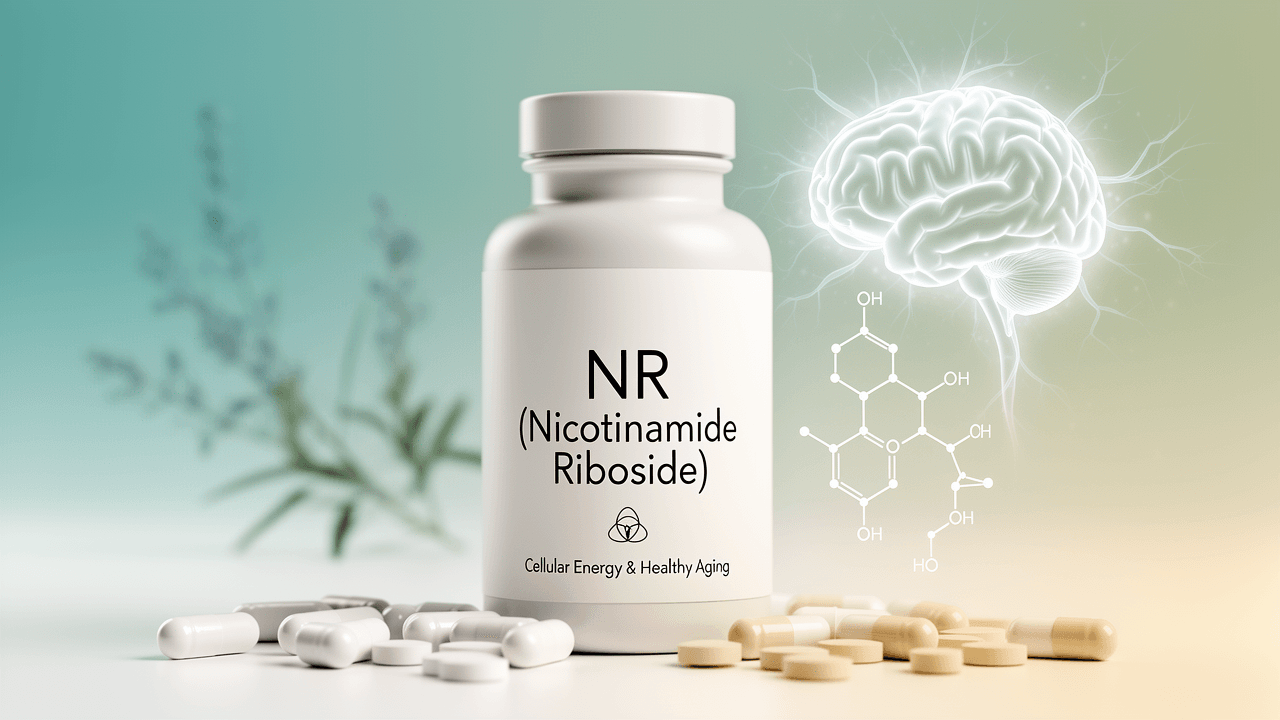
Nicotinamide riboside (NR) is a vitamin B3 (niacin) derivative and a direct precursor to nicotinamide adenine dinucleotide (NAD⁺), a central coenzyme in cellular energy production and metabolism.
NR is naturally present in trace amounts in foods such as milk and yeast, but the quantities in a normal diet are very low. As a supplement, NR is usually provided as nicotinamide riboside chloride (often branded as Niagen®), which has been granted Generally Recognized as Safe (GRAS) status in the U.S.
How NR Works in the Body
NR’s primary role is to serve as a precursor to NAD⁺, a molecule required for:
- Mitochondrial energy production (oxidative phosphorylation / ATP generation)
- Redox reactions in carbohydrate, fat, and protein metabolism
- DNA repair via PARPs (poly-ADP ribose polymerases)
- Cell stress responses and longevity pathways via sirtuins (SIRT1–SIRT7)
NR → NAD⁺ Conversion Pathway
- NR enters cells through specific nucleoside transporters.
- It is phosphorylated by nicotinamide riboside kinases (NRK1/NRK2) to nicotinamide mononucleotide (NMN).
- NMN is then converted to NAD⁺ by NMN adenylyltransferases (NMNATs).
Compared to traditional niacin or nicotinamide, NR:
- Raises NAD⁺ with less flushing and fewer side effects than high-dose niacin.
- May more efficiently boost NAD⁺ in certain tissues (based on animal and cell data), though human tissue-specific data are limited.
Why NAD⁺ Matters
NAD⁺ levels decline with age and in various conditions (obesity, type 2 diabetes, neurodegeneration, chronic inflammation). Lower NAD⁺ is linked to:
- Mitochondrial dysfunction
- Increased oxidative stress
- Impaired DNA repair
- Metabolic inflexibility
By replenishing NAD⁺, NR is hypothesized to support healthy aging, metabolic health, and cellular resilience. However, evidence is stronger in animals than in humans, and many human outcomes are still exploratory.
2. Key Benefits of Nicotinamide Riboside (NR)
1. Increases NAD⁺ Levels
The most consistent, well-documented effect of NR is a dose-dependent increase in blood NAD⁺ levels.
- Multiple human trials show ~40–100% increases in blood NAD⁺ with daily NR supplementation.
- This effect is typically seen within 1–2 weeks and maintained with continued use.
2. Supports Cellular Energy Metabolism
By boosting NAD⁺, NR may:
- Enhance mitochondrial function and ATP production
- Improve metabolic flexibility (ability to switch between carb and fat burning)
- Support exercise recovery and reduce perceived fatigue (evidence is mixed and still emerging)
Human data so far suggest modest improvements in some metabolic markers, but not dramatic changes in body weight or insulin sensitivity in otherwise healthy individuals.
3. Potential Cardiometabolic Benefits
NR has shown some beneficial effects on blood pressure and arterial health in specific populations:
- May reduce systolic blood pressure and arterial stiffness in adults with elevated baseline values.
- May modestly improve certain lipid or inflammatory markers in some studies, though results are inconsistent.
4. Investigational Neuroprotective and Healthy Aging Effects
In animal and preclinical models, NR shows promise in:
- Protecting neurons against injury and oxidative stress
- Supporting cognitive function in models of neurodegeneration
- Improving lifespan or healthspan in certain models
Human data on cognition, neurodegeneration, and longevity outcomes are still very limited and preliminary. NR should not be viewed as a proven anti-aging or neuroprotective therapy at this time.
3. Research Findings on NR
Below are selected human and relevant animal studies, with emphasis on design, dose, and outcomes.
3.1 Human Studies: NAD⁺ and Metabolic Health
NR Increases NAD⁺ in Healthy Adults
Study: Trammell et al., 2016, Nature Communications
- Design: Randomized, double-blind, crossover
- Participants: 12 healthy men
- Dose: 100, 300, and 1,000 mg NR (single doses) vs placebo
- Findings:
- Dose-dependent increases in blood NAD⁺ metabolites
- Repeated dosing (over 7 days) with 1,000 mg/day increased blood NAD⁺ by ~2-fold
- NR was well tolerated without flushing
NR in Middle-Aged and Older Adults
Study: Martens et al., 2018, Nature Communications
- Design: Randomized, double-blind, placebo-controlled
- Participants: 24 healthy, overweight but otherwise non-diabetic adults (ages 55–79)
- Dose: 500 mg NR twice daily (1,000 mg/day) vs placebo for 6 weeks
- Key Results:
- Whole blood NAD⁺ increased by ~60%
- Systolic blood pressure decreased by ~9 mmHg in those with elevated baseline BP
- Aortic stiffness (carotid-femoral pulse wave velocity) improved in those with higher baseline values
- No significant changes in insulin sensitivity or body composition
Interpretation: NR reliably raises NAD⁺ and may improve vascular health in individuals with higher cardiometabolic risk, but metabolic changes (e.g., insulin sensitivity) were modest.
NR in Obese, Insulin-Resistant Men
Study: Dollerup et al., 2018, Cell Metabolism
- Design: Randomized, double-blind, placebo-controlled
- Participants: 40 obese, insulin-resistant men
- Dose: 1,000 mg NR/day for 12 weeks
- Findings:
- Whole blood NAD⁺ increased significantly
- No improvement in insulin sensitivity (measured by hyperinsulinemic-euglycemic clamp)
- No significant changes in hepatic fat content, energy expenditure, or body composition
- NR was generally safe and well tolerated
Interpretation: In this population, NR increased NAD⁺ but did not improve insulin resistance or weight over 12 weeks.
3.2 Cardiovascular and Inflammatory Markers
Blood Pressure and Arterial Stiffness
The Martens et al. 2018 study (above) is the most cited human trial suggesting NR may benefit blood pressure and arterial stiffness in older adults with elevated values.
Inflammation and Lipid Markers
Study: Elhassan et al., 2019, Journal of Gerontology: Series A
- Design: Randomized, double-blind, placebo-controlled
- Participants: 24 healthy older men (ages 70–80)
- Dose: 1,000 mg NR/day for 3 weeks
- Findings:
- Increased skeletal muscle NAD⁺ metabolites
- No major changes in mitochondrial function at rest
- Some changes in inflammatory gene expression, but clinical significance uncertain
Overall, cardiometabolic effects in humans are subtle and variable, not transformative.
3.3 Exercise and Muscle Function
Evidence is mixed, with some animal data suggesting improved endurance and mitochondrial function, but human trials are less convincing.
Study: Dollerup et al., 2020, Journal of Physiology
- Design: Randomized, double-blind, placebo-controlled
- Participants: 32 lean, healthy men
- Dose: 1,000 mg NR/day for 6 weeks
- Findings:
- Increased blood NAD⁺ and some muscle NAD⁺ metabolites
- No improvement in exercise performance or mitochondrial respiration
Interpretation: NR raises NAD⁺ but does not necessarily enhance exercise capacity in young, healthy individuals.
3.4 Neuroprotection and Cognitive Function (Preclinical)
Human cognitive data are scarce; most evidence comes from animals.
- In mouse models of neurodegeneration (e.g., Alzheimer’s, Parkinson’s models), NR has:
- Reduced neuronal damage and neuroinflammation
- Improved cognitive performance in maze tests
- Enhanced synaptic plasticity
- In models of nerve injury and hearing loss, NR has shown protective effects.
However, no large, high-quality human trials have yet demonstrated clear cognitive or neuroprotective benefits.
3.5 Longevity and Aging (Preclinical)
In various animal and cell models, NR:
- Extends lifespan in some yeast and worm models via sirtuin activation
- Improves healthspan markers (e.g., mitochondrial function, physical activity) in aged mice
- Enhances DNA repair capacity in response to genotoxic stress
These findings are promising but not directly translatable to human lifespan at this time. NR should be seen as a potential cellular support compound, not a proven life-extension therapy.
4. Best Sources & Dosage of Nicotinamide Riboside
4.1 Supplemental Forms
NR is available primarily as:
- Nicotinamide riboside chloride (most common, often branded as Niagen®)
- Capsules or tablets, typically 100–500 mg per serving
NR is distinct from:
- Nicotinamide mononucleotide (NMN) – another NAD⁺ precursor; similar goals but different molecule
- Niacin (nicotinic acid) – older form of vitamin B3, can cause flushing at higher doses
- Nicotinamide (niacinamide) – non-flushing B3 form, but high doses may inhibit sirtuins
4.2 Typical Dosage Ranges
Evidence-based human doses generally fall between 250–2,000 mg/day, with most studies using 500–1,000 mg/day.
Below are practical ranges based on current data (not medical advice; discuss with a clinician):
1. General Wellness / Healthy Aging Support
- Common dose: 250–500 mg once daily
- Rationale: Lower end of doses shown to raise NAD⁺, potentially adequate for maintenance in otherwise healthy adults.
2. Cardiometabolic Support (Older / Overweight Adults)
- Studied dose: 1,000 mg/day (often divided as 500 mg twice daily)
- Duration in studies: 6–12 weeks
- Goal: Raise NAD⁺ and possibly support vascular health in individuals with elevated blood pressure or metabolic risk.
3. Higher Experimental Doses
- Doses up to 2,000 mg/day have been tested in clinical trials and found to be generally well tolerated for several weeks to months.
- Higher doses are sometimes used in research settings for exploring effects on specific conditions, but long-term safety data are limited.
4.3 Timing and Administration
- With or without food: NR can be taken with or without meals; some people prefer with food to minimize any mild GI discomfort.
- Once vs twice daily: Many studies use twice-daily dosing (e.g., 500 mg morning, 500 mg evening) to maintain more stable NAD⁺ levels.
- Stacking with other supplements: Often combined with:
- Other NAD⁺ precursors (e.g., NMN – though combining is not well studied)
- Mitochondrial support compounds (e.g., CoQ10, alpha-lipoic acid)
- Antioxidants (e.g., vitamin C, polyphenols)
Because formal combination trials are limited, stacking strategies are based more on theoretical synergy than strong clinical evidence.
4.4 Onset and Duration of Effects
- NAD⁺ increase: Typically within 1–2 weeks of regular dosing
- Subjective effects: Some users report subtle improvements in energy or recovery within weeks, but this is highly individual and not consistently observed in trials.
- Long-term use: Human data beyond 6–12 months are sparse; periodic reassessment with a clinician is advisable.
5. Safety, Side Effects, and Interactions
5.1 Overall Safety Profile
Across multiple human trials, NR has been well tolerated at doses up to 2,000 mg/day for several weeks to a few months.
Commonly reported side effects are usually mild:
- Nausea or mild stomach discomfort
- Diarrhea or loose stools
- Headache
- Fatigue in some individuals
These effects are generally dose-dependent and may improve with taking NR with food or reducing the dose.
5.2 Laboratory and Organ Function Markers
Most human studies have not found major adverse changes in:
- Liver enzymes (ALT, AST)
- Kidney function (creatinine, BUN)
- Blood counts
However, a few studies have reported subtle changes in certain markers (e.g., mild increases in homocysteine in some niacin-related interventions, though NR-specific data are limited). Regular monitoring may be prudent with long-term use, especially at higher doses.
5.3 Potential Long-Term Concerns (Theoretical)
Because NR boosts NAD⁺, which fuels both protective and potentially pathologic processes, there are theoretical concerns:
Cancer Risk
- NAD⁺ is required for DNA repair and cell survival; in theory, this could help both healthy and malignant cells.
- Animal data are mixed; some suggest improved DNA repair and reduced tumorigenesis under certain conditions, others raise concern that high NAD⁺ could support existing cancer cell metabolism.
- Currently, there is no clear human evidence that NR increases or decreases cancer risk, but caution is advised in individuals with active malignancy or strong cancer history.
Immune and Inflammatory Modulation
- NAD⁺-dependent enzymes (e.g., PARPs, sirtuins) influence inflammatory pathways.
- NR may have anti-inflammatory effects in some contexts, but the net long-term impact on immune function in humans is not fully defined.
Methyl Donor Depletion (Shared with Other B3 Forms)
- High doses of nicotinamide can consume methyl groups during metabolism, potentially affecting homocysteine levels.
- NR metabolism overlaps with nicotinamide pathways; while not definitively shown, some practitioners recommend ensuring adequate intake of folate, B6, and B12 when using higher doses chronically.
5.4 Drug and Supplement Interactions
Direct, well-documented interactions are limited, but several considerations are prudent:
Chemotherapy and Cancer Therapies
- Some chemotherapeutic agents and radiation rely on inducing DNA damage and cell death.
- Because NAD⁺ supports DNA repair and cell survival, there is concern that NR could interfere with cancer treatments or support tumor survival.
- Individuals undergoing cancer therapy should not use NR without explicit oncologist approval.
Immunosuppressive or Immunomodulatory Drugs
- Given NAD⁺’s role in immune cell function, interactions are theoretically possible, though not well characterized.
Other NAD⁺ Precursors (Niacin, NMN, Nicotinamide)
- Combining high doses of multiple NAD⁺ precursors may:
- Exaggerate side effects (GI upset, liver stress at very high B3 intakes)
- Increase uncertainty around long-term safety
- If stacking, total B3-equivalent intake should be considered.
- Combining high doses of multiple NAD⁺ precursors may:
Liver-Active Medications
- While NR has not shown strong hepatotoxicity signals at studied doses, caution is reasonable when combined with other potentially hepatotoxic drugs (e.g., high-dose acetaminophen, certain antifungals, methotrexate).
5.5 Special Populations
Pregnant or Breastfeeding Women
- Safety data for NR in pregnancy and lactation are insufficient.
- Standard prenatal vitamins already include vitamin B3; additional NR should only be used under medical supervision.
Children and Adolescents
- No robust clinical trials in minors.
- NR is generally not recommended for children unless part of a supervised clinical protocol.
People with Liver or Kidney Disease
- Limited data on NR in significant hepatic or renal impairment.
- Use cautiously and only under physician guidance, with periodic monitoring of liver and kidney function.
Individuals with a History of Cancer
- Due to theoretical concerns about supporting tumor metabolism, those with a history of cancer should consult their oncologist before using NR.
6. Who Should and Shouldn’t Use Nicotinamide Riboside
6.1 Who Might Consider NR
NR may be reasonable to consider (with clinician input) for:
Middle-Aged and Older Adults Focused on Healthy Aging
- Goal: Support cellular NAD⁺, mitochondrial function, and vascular health
- Typical dose: 250–500 mg/day, possibly up to 1,000 mg/day if well tolerated
Individuals with Age-Related NAD⁺ Decline or High Oxidative Stress
- Those with high cardiometabolic risk (e.g., elevated blood pressure, overweight, prediabetes) may consider NR as part of a broader lifestyle program.
- NR should complement, not replace, diet, exercise, sleep, and medical management.
Research and Clinical Trial Participants
- NR is being studied in conditions such as neurodegenerative diseases, mitochondrial disorders, and metabolic syndrome.
- Participation in formal trials ensures monitoring and contributes to the evidence base.
6.2 Who Should Use Caution or Avoid NR
People with Active Cancer or Undergoing Cancer Treatment
- Due to uncertain effects on tumor metabolism and therapy response, NR should generally be avoided unless explicitly cleared by an oncologist.
Pregnant or Breastfeeding Women
- Insufficient safety data; standard prenatal care is preferable.
Children and Adolescents
- Lack of pediatric safety data; avoid outside of clinical research.
Individuals with Significant Liver or Kidney Disease
- Use only under close medical supervision, if at all.
Those on Complex Medication Regimens
- Particularly those on chemotherapeutics, immunosuppressants, or drugs with narrow therapeutic windows should check for potential interactions with a healthcare provider.
7. Practical Takeaways
- Mechanism: NR is a vitamin B3 derivative that efficiently boosts NAD⁺, a key coenzyme for energy production, DNA repair, and cell survival.
- Evidence: Human trials consistently show increased NAD⁺ levels; clinical benefits on metabolism, blood pressure, and exercise performance are modest and variable.
- Dosing: Common supplemental doses are 250–1,000 mg/day, with higher doses (up to 2,000 mg/day) used in research settings.
- Safety: Generally well tolerated short-term; long-term safety and cancer-related implications remain uncertain.
- Best Use: As a supportive, experimental adjunct for healthy aging and cardiometabolic support, not a standalone cure or guaranteed longevity agent.
Anyone considering NR—especially at higher doses or with medical conditions—should discuss it with a qualified healthcare professional, ideally one familiar with NAD⁺ biology and current research.