1. Understanding Beta-Alanine – What It Is and How It Works
What is Beta-Alanine?
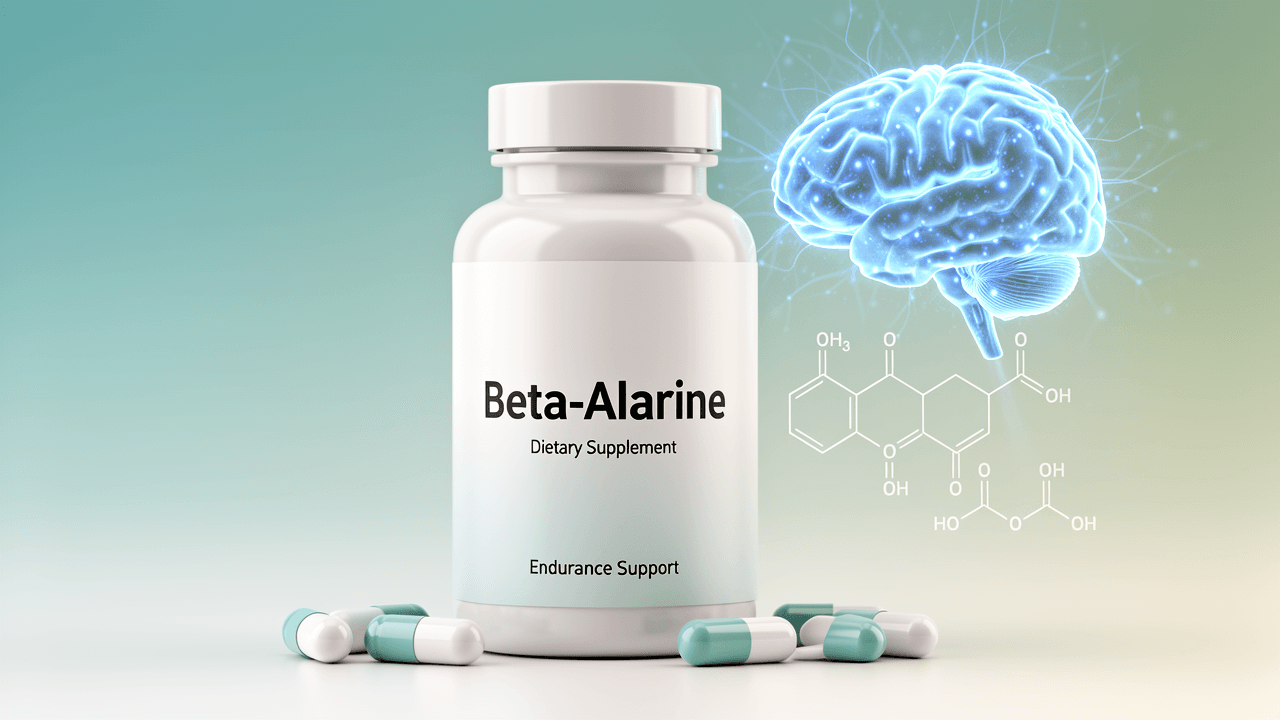
Beta-alanine is a non-essential amino acid that the body can produce on its own and also obtain from food, mainly animal products like meat and poultry. Unlike many amino acids, beta-alanine is not used to build proteins directly. Instead, its primary role is as a building block for carnosine, a dipeptide made from beta-alanine and histidine.
Carnosine is highly concentrated in skeletal muscle and, to a lesser extent, in the brain and heart. It acts as an intracellular pH buffer, helping to neutralize acid (hydrogen ions) that builds up during high-intensity exercise.
How Beta-Alanine Works in the Body
Carnosine Synthesis
- Beta-alanine combines with histidine in muscle cells to form carnosine via the enzyme carnosine synthetase.
- In muscle, beta-alanine is the rate-limiting substrate for carnosine production (histidine is typically abundant).
- Supplementing beta-alanine reliably increases muscle carnosine levels.
Intramuscular Buffering and Fatigue Resistance
During high-intensity exercise (e.g., sprinting, heavy lifting):- Muscles rely more on anaerobic glycolysis, producing lactic acid.
- Lactic acid dissociates into lactate and hydrogen ions (H⁺).
- Accumulation of H⁺ lowers muscle pH (acidosis), which impairs enzyme function and reduces force production.
- Carnosine helps buffer these H⁺ ions, delaying the drop in pH, and thereby slowing fatigue.
Potential Neurological and Nootropic Roles
While most research focuses on muscle, carnosine and beta-alanine are also present in the brain:- Carnosine has antioxidant, anti-glycation, and metal-chelating properties in vitro and in animal models.
- These actions may help protect neurons from oxidative stress and metabolic damage.
- However, direct evidence that beta-alanine supplementation improves cognition in healthy humans is limited; most cognitive findings are secondary outcomes in athletic studies (e.g., improved performance under fatigue).
Time Course of Effects
- Beta-alanine does not act acutely like caffeine.
- It requires chronic supplementation (typically 2–4+ weeks) to meaningfully raise muscle carnosine.
- Benefits are most apparent in exercise lasting ~30 seconds to 10 minutes, where acidosis is a key performance limiter.
2. Key Benefits of Beta-Alanine
1. Improved High-Intensity Exercise Performance
The most consistent benefit of beta-alanine is improved performance in short to mid-duration, high-intensity efforts (~30 seconds to 10 minutes):
- Enhanced capacity for repeated sprints or intervals.
- Greater total work done in high-intensity sets.
- Small but meaningful improvements in time-to-exhaustion and time-trial performance.
These benefits are most relevant to sports like sprinting, rowing, cycling, combat sports, and team sports requiring repeated bursts of high effort.
2. Increased Training Volume and Work Capacity
By delaying fatigue during challenging sets, beta-alanine can allow:
- More reps at a given weight.
- Longer intervals or more total intervals.
- Higher training volume over weeks, which can indirectly support adaptations like strength, power, and muscle hypertrophy.
The effect size is modest but can be meaningful for competitive athletes and serious trainees.
3. Potential Cognitive and Anti-Fatigue Effects Under Stress
Some research suggests beta-alanine may help maintain performance under conditions of physical and cognitive stress, for example:
- Sustained military operations.
- Prolonged, demanding exercise with a mental component (e.g., decision-making in sport).
These effects appear to be secondary to reduced physical fatigue and possibly improved buffering in the central nervous system, rather than a strong direct nootropic effect.
4. Possible Neuroprotective and Healthy Aging Roles (Preliminary)
Animal and cell studies indicate that carnosine may:
- Reduce oxidative stress and lipid peroxidation.
- Inhibit protein glycation and cross-linking (processes implicated in aging and neurodegeneration).
- Modulate metal ion (e.g., copper, zinc) interactions in the brain.
However, human evidence linking beta-alanine supplementation to long-term brain health or cognitive enhancement is currently limited and indirect. These potential benefits should be considered speculative.
3. Research Findings on Beta-Alanine
Overview of the Evidence Base
Beta-alanine is one of the most studied performance supplements, alongside creatine and caffeine. Multiple systematic reviews and meta-analyses support its efficacy for specific exercise types.
Meta-Analysis: Performance in 1–4 Minute Exercise
- Saunders et al., 2017 (Amino Acids)
- Design: Systematic review and meta-analysis of 40 studies (65 exercise tests) on beta-alanine and exercise performance.
- Typical dose: 4–6 g/day for 2–12 weeks.
- Key findings:
- Overall, beta-alanine improved exercise capacity with a small-to-moderate effect size.
- Greatest benefit observed in exercise bouts lasting 30 seconds to 10 minutes, especially 1–4 minutes (e.g., 400–1500 m running, 1–4 min cycling).
- Minimal effect on efforts <30 seconds or >25 minutes.
Muscle Carnosine Increases
- Harris et al., 2006 (Amino Acids)
- Participants: Healthy adults (n ≈ 25 across experiments).
- Intervention: Beta-alanine 3.2–6.4 g/day for 4–10 weeks.
- Key findings:
- Muscle carnosine increased by ~40–60% after 4 weeks and up to ~80% after 10 weeks.
- Histidine alone did not raise carnosine, confirming beta-alanine as the limiting factor.
High-Intensity Cycling Performance
- Hill et al., 2007 (Journal of Applied Physiology)
- Participants: 25 male recreationally active subjects.
- Design: Double-blind, placebo-controlled.
- Intervention: Beta-alanine 4–6.4 g/day for 10 weeks vs placebo.
- Outcomes: Cycling capacity at 110% of VO₂max.
- Results:
- Time to exhaustion increased by 13% after 4 weeks and by 16% after 10 weeks in the beta-alanine group.
- Muscle carnosine increased by 58% at 4 weeks and 80% at 10 weeks.
- Placebo group showed no significant changes.
Rowing Performance in Trained Athletes
- Baguet et al., 2010 (International Journal of Sport Nutrition and Exercise Metabolism)
- Participants: 18 elite rowers.
- Design: Double-blind, placebo-controlled.
- Intervention: Beta-alanine 5 g/day for 7 weeks vs placebo.
- Outcome: 2000 m rowing time trial.
- Results:
- Beta-alanine group improved their 2000 m time by 2.0 seconds vs placebo.
- Muscle carnosine increased by ~45–80% (depending on muscle group).
- Interpretation: Small but meaningful performance gains at elite level.
Resistance Training and Volume
- Kendrick et al., 2008 (Medicine & Science in Sports & Exercise)
- Participants: 26 recreationally active males.
- Design: Double-blind, placebo-controlled.
- Intervention: Beta-alanine 6.4 g/day for 4 weeks vs placebo, combined with resistance training.
- Outcome: Number of repetitions to failure at 70% 1RM in squat and bench press.
- Results:
- Beta-alanine group performed significantly more reps at 70% 1RM vs placebo, indicating improved muscular endurance.
- Strength (1RM) improvements were modest and not consistently different from placebo.
Cognitive and Military Performance
- Hoffman et al., 2014 (Physiology & Behavior)
- Participants: 20 soldiers in a simulated military operation.
- Design: Double-blind, placebo-controlled.
- Intervention: Beta-alanine 6 g/day for 4 weeks.
- Outcomes: Marksmanship, cognitive tests, and physical performance under fatigue.
- Results:
- Beta-alanine group showed better performance on some cognitive tasks and marksmanship measures under fatigue compared to placebo.
- Authors suggested improved resilience to physical and mental stress, likely mediated by reduced peripheral fatigue and possibly central effects.
- Limitation: Small sample size; findings need replication.
Summary of the Evidence
- Strong evidence: Increased muscle carnosine; improved performance in 30 s–10 min high-intensity exercise; increased training volume in some contexts.
- Moderate evidence: Enhanced performance in real-world sports (rowing, combat, team sports) with small but relevant improvements.
- Preliminary evidence: Cognitive/anti-fatigue benefits under extreme stress; neuroprotective roles via carnosine (largely preclinical).
- Limited or no evidence: Direct cognitive enhancement in healthy individuals at rest; major benefits for long-duration, low-intensity endurance events.
4. Best Sources & Dosage – Forms, Dosing, Timing, Safety
Common Forms of Beta-Alanine
Standalone Beta-Alanine Powder or Capsules
- Usually the most cost-effective.
- Allows flexible dosing (e.g., splitting into smaller doses to reduce tingling).
Pre-Workout Blends
- Frequently include 1.6–3.2 g beta-alanine per serving.
- Convenient but less flexible; may not provide the full daily dose in one serving.
Sustained-Release Beta-Alanine
- Formulated to release more slowly, which can reduce paresthesia (tingling).
- Often more expensive but better tolerated at higher single doses.
Evidence-Based Dosage Recommendations
General Performance and Training
Standard loading dose:
- 4–6 g/day, divided into 2–4 smaller doses (e.g., 2 x 2 g or 4 x 1.5 g) to reduce tingling.
- Duration: At least 4 weeks, with 8–12 weeks providing larger increases in carnosine.
Maintenance (after 8–12 weeks):
- Muscle carnosine declines slowly after stopping supplementation (half-life ~9–15 weeks).
- A lower dose of 1.2–1.6 g/day may help maintain elevated carnosine levels, though research on maintenance strategies is less robust.
For Athletes in High-Intensity Sports
- Target users: Sprinters, rowers, cyclists (1–4 min events), combat athletes, team sports with repeated sprints.
- Protocol:
- 4–6 g/day, divided, for 8–12 weeks leading into key competition periods.
- Consider sustained-release forms if tingling is problematic.
For Resistance Training / Hypertrophy
- Goal: Improve muscular endurance and training volume, not a direct strength booster.
- Protocol:
- 3.2–6 g/day, divided, for at least 4–8 weeks.
- Combine with structured resistance training and adequate protein intake.
For Potential Cognitive / Anti-Fatigue Benefits
- Evidence is limited; dosing is typically similar to athletic protocols.
- 3.2–6 g/day for 4+ weeks has been used in studies involving military personnel and high-stress conditions.
- Until more data are available, beta-alanine should be viewed primarily as a performance supplement with possible secondary cognitive resilience benefits, not a primary nootropic.
Timing Considerations
- Not time-sensitive like caffeine; benefits depend on long-term carnosine accumulation.
- Beta-alanine can be taken with or without food, though some people find it more comfortable with meals.
- Many users take part of the dose pre-workout for convenience, but this is not necessary for efficacy.
Safety, Side Effects, and Interactions
Overall Safety Profile
- Beta-alanine is generally considered safe for healthy adults at doses of up to ~6.4 g/day for at least 12 weeks in clinical studies.
- Long-term safety data beyond 1–2 years are limited but available data are reassuring at typical sports doses.
Common Side Effect: Paresthesia (Tingling)
- Characterized by tingling, prickling, or flushing sensations, usually on the face, neck, or hands.
- Most common when single doses exceed ~800–1000 mg, especially 1.6–3.2 g at once.
- Onset: Within 15–30 minutes of ingestion.
- Duration: Typically 30–60 minutes.
- Mechanism: Likely related to activation of cutaneous sensory nerve endings; not harmful but can be uncomfortable.
How to minimize tingling:
- Use smaller, divided doses (e.g., 800–1000 mg, 3–6 times per day).
- Use sustained-release formulations.
- Take with meals.
- Gradually increase dose over a week.
Other Adverse Effects
At standard doses in healthy adults, studies generally report no significant changes in:
- Liver enzymes.
- Kidney function markers.
- Blood lipids or glucose (within normal ranges).
However, individuals with pre-existing medical conditions should exercise caution (see below).
Potential Interactions and Special Considerations
Taurine Interaction (Theoretical)
- Beta-alanine and taurine share some transporters in tissues.
- High-dose beta-alanine has been shown in some animal studies to reduce tissue taurine levels.
- In humans, short- to medium-term studies at sports doses have not consistently shown problematic taurine depletion, but long-term, high-dose use is less studied.
- If using beta-alanine chronically at high doses, ensuring adequate dietary taurine (from animal proteins) or moderate taurine supplementation may be prudent, especially for vegans.
Interactions with Other Stimulants or Pre-Workouts
- Beta-alanine is often combined with caffeine, creatine, and other ingredients.
- There is no strong evidence of harmful interactions at typical doses, but high-stimulant pre-workouts may cause compounded side effects (jitters, insomnia, GI discomfort).
- Sensitive individuals should monitor total caffeine and stimulant intake.
Kidney or Liver Disease
- People with significant kidney or liver impairment were generally excluded from trials.
- Amino acid metabolism can be altered in these conditions.
- Use only under medical supervision, if at all.
Pregnancy and Breastfeeding
- There is insufficient safety data on beta-alanine use during pregnancy or lactation.
- It is generally recommended to avoid non-essential supplements like beta-alanine in these populations unless specifically recommended by a healthcare provider.
Children and Adolescents
- Limited data exist for those under 18.
- Because it is non-essential and mainly performance-oriented, beta-alanine is not routinely recommended for minors unless under professional guidance (e.g., sports physician or dietitian).
Medications
- No major, well-documented drug interactions have been established.
- However, due to limited data, caution is advised for those taking:
- Neurological medications (anticonvulsants, neuropathic pain agents), given beta-alanine’s effects on nerve sensations.
- Renally cleared drugs, in individuals with kidney issues.
- Always discuss with a healthcare provider if you are on prescription medications.
Who Should Consider Using Beta-Alanine?
Potentially good candidates:
- Competitive athletes in sports requiring repeated high-intensity efforts (sprints, rowing, swimming, combat sports, team sports).
- Recreational lifters and trainees who prioritize muscular endurance and training volume.
- Individuals in high-physical-stress occupations (e.g., military, firefighters) where sustaining performance under fatigue is critical.
Less likely to benefit substantially:
- People whose primary activity is low-intensity, long-duration endurance (e.g., easy marathon pace, long hikes) without major high-intensity components.
- Individuals seeking a pure cognitive enhancer; current evidence does not support beta-alanine as a primary nootropic.
Who Should Be Cautious or Avoid Beta-Alanine?
You should not use or should only use beta-alanine under medical supervision if:
- You have moderate to severe kidney disease or significant liver disease.
- You are pregnant or breastfeeding, due to lack of data.
- You are under 18, unless guided by a qualified professional.
- You have a history of unexplained neuropathy or severe sensitivity to tingling or flushing.
- You are taking multiple prescription medications and have not discussed supplement use with your clinician.
Practical Takeaways
- Beta-alanine is a well-researched supplement that increases muscle carnosine and improves performance in short to mid-duration high-intensity exercise, with modest but reliable benefits.
- It is not an acute stimulant; benefits require weeks of consistent use at 3.2–6 g/day.
- Side effects are usually limited to temporary tingling, which can be minimized by splitting doses or using sustained-release forms.
- Evidence for direct nootropic or long-term brain health benefits in humans is preliminary; beta-alanine should be viewed primarily as a performance enhancer with possible secondary cognitive resilience effects.
- Healthy adults engaged in intense training are the best candidates; individuals with medical conditions, pregnant or breastfeeding women, and minors should be cautious and seek professional guidance before using beta-alanine.