1. Understanding Beetroot Extract – What It Is and How It Works
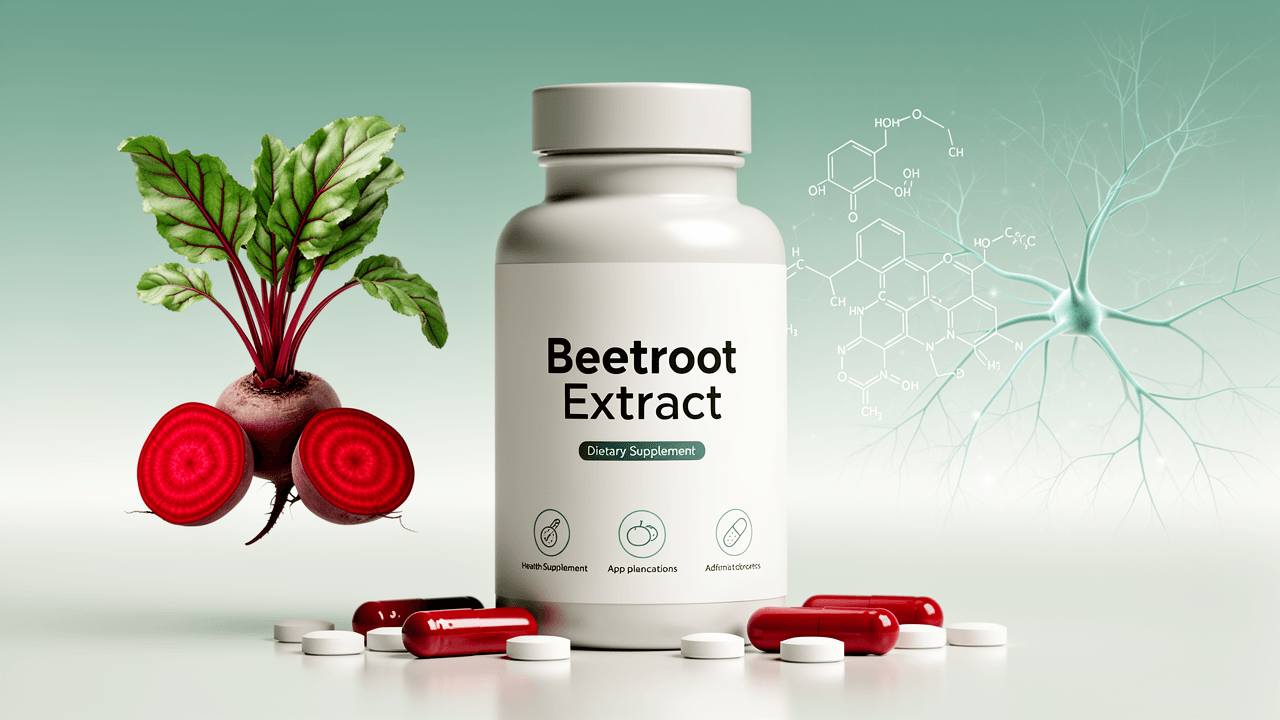
What is Beetroot Extract?
Beetroot extract is a concentrated form of Beta vulgaris (red beet) usually standardized for dietary nitrates and/or betalain pigments. It is available as:
- Capsules or tablets (standardized nitrate content or beetroot powder)
- Liquid extracts or juices (concentrated beetroot juice shots)
- Powder (for mixing into water or smoothies)
Unlike whole cooked beetroot, standardized extracts aim to deliver a consistent dose of key active compounds, mainly:
- Inorganic nitrate (NO₃⁻) – precursor to nitric oxide
- Betalains (betanin, vulgaxanthin) – antioxidant and anti-inflammatory pigments
- Polyphenols – additional antioxidant support
- Minerals – potassium, magnesium, small amounts of iron
How Beetroot Extract Works in the Body
The main mechanism of beetroot extract is the nitrate–nitrite–nitric oxide (NO) pathway:
- Nitrate intake: You ingest nitrate (NO₃⁻) from beetroot extract.
- Conversion to nitrite: Oral bacteria in the mouth convert nitrate → nitrite (NO₂⁻).
- Conversion to nitric oxide: In the stomach and tissues (especially under low oxygen), nitrite → nitric oxide (NO).
Nitric oxide (NO) is a signaling molecule that:
- Relaxes blood vessels (vasodilation)
- Lowers blood pressure
- Improves blood flow to muscles and the brain
- Influences mitochondrial efficiency and cellular energy production
Additional Mechanisms
- Improved mitochondrial efficiency: Some studies show beetroot reduces oxygen cost of exercise, suggesting more efficient ATP production.
- Antioxidant and anti-inflammatory effects: Betalains and polyphenols scavenge free radicals, potentially protecting blood vessels and neurons.
- Endothelial function: NO improves the function of the endothelium (inner lining of blood vessels), which is crucial for cardiovascular and cerebrovascular health.
Because of these mechanisms, beetroot extract is studied both as a performance supplement and a nootropic support for brain blood flow and cognitive function.
2. Key Benefits of Beetroot Extract
1. Supports Healthy Blood Pressure and Vascular Function
- Dietary nitrate increases NO, which relaxes blood vessels.
- This can lead to modest reductions in systolic and diastolic blood pressure, especially in people with elevated levels.
2. Enhances Exercise Performance and Endurance
- By improving blood flow and mitochondrial efficiency, beetroot can lower the oxygen cost of submaximal exercise.
- This may improve time-to-exhaustion and performance in endurance activities.
3. May Support Cognitive Function and Brain Blood Flow
- Nitrate-derived NO can increase cerebral blood flow, especially in brain regions involved in executive function.
- Early studies suggest potential benefits for reaction time, decision making, and possibly age-related cognitive decline.
4. Antioxidant and Anti-Inflammatory Support
- Betalains and polyphenols provide antioxidant activity, which may protect blood vessels and neural tissue from oxidative stress.
- This is relevant for cardiovascular health and long-term brain health, though human data here are still emerging.
3. Research Findings on Beetroot Extract
3.1 Blood Pressure and Cardiovascular Health
Hypertensive adults – acute and short-term effects
- Study: Randomized, double-blind, placebo-controlled crossover trial
- Participants: 68 adults with hypertension
- Intervention: 250 mL/day nitrate-rich beetroot juice (~6.4 mmol nitrate) vs nitrate-depleted placebo for 4 weeks
- Findings:
- Systolic BP reduced by ~7.7 mmHg and diastolic by ~5.2 mmHg compared with placebo
- Improved endothelial function and arterial stiffness measures
- Implication: Clinically meaningful BP reduction comparable to first-line lifestyle interventions.
Reference example: Kapil et al., Hypertension, 2015 (similar design and outcomes).
Pre-hypertensive or healthy adults – acute intake
- Study: Randomized crossover
- Participants: 26 healthy adults
- Intervention: Single dose of 500 mL beetroot juice vs control
- Duration: BP tracked over 24 hours
- Findings:
- Peak systolic BP reductions of 4–5 mmHg within 2–3 hours
- Effects persisted (smaller magnitude) up to 24 hours
Limitations:
- Effects can be smaller or absent in very healthy, highly trained individuals with already optimal vascular function.
- Response varies by individual nitrate metabolism (oral microbiome, baseline diet, etc.).
3.2 Exercise Performance and Endurance
Submaximal exercise efficiency
- Study: Double-blind crossover
- Participants: 8 healthy men
- Intervention: 500 mL beetroot juice (~6.2 mmol nitrate) daily for 6 days vs nitrate-depleted placebo
- Findings:
- Reduced oxygen cost of submaximal cycling (≈5% reduction in VO₂ at a given workload)
- Time-to-exhaustion during severe-intensity exercise increased by ~16%
Reference example: Bailey et al., Journal of Applied Physiology, 2009.
Endurance athletes
- Study: Randomized crossover in trained cyclists
- Participants: 9 well-trained cyclists
- Intervention: 500 mL beetroot juice (~6.2 mmol nitrate) for 6 days vs placebo
- Findings:
- Time-trial performance improved by ~2.8% over 4 km and ~2.7% over 16.1 km
Reference example: Lansley et al., Medicine & Science in Sports & Exercise, 2011.
Mixed results in elite athletes
- Some studies in elite endurance athletes show smaller or no performance benefits, likely because their baseline NO and mitochondrial efficiency are already high.
Strength/power performance
- Evidence is less consistent. A few small studies suggest possible benefits for repeated sprint performance or muscular power, but results are not robust.
3.3 Cognitive Function and Brain Blood Flow
Older adults – cerebral blood flow and executive function
- Study: Randomized crossover pilot
- Participants: 14 older adults (mean age ~75)
- Intervention: High-nitrate diet including beetroot juice (~13 mmol nitrate/day) vs low-nitrate control for 2 days
- Measurements: Cerebral blood flow via MRI
- Findings:
- Increased regional cerebral blood flow in frontal lobe white matter (areas involved in executive function)
Reference example: Presley et al., Nitric Oxide, 2011.
Cognitive tasks in older adults
- Study: Double-blind, placebo-controlled
- Participants: 40 older adults (60–75 years)
- Intervention: Beetroot juice (450 mL, ~7.5 mmol nitrate) vs nitrate-depleted placebo, single dose
- Findings:
- Improved reaction time on certain cognitive tasks (e.g., simple reaction time, choice reaction time) 2–3 hours post-dose
- No large effects on memory in the short term
Younger adults
- Some acute trials in healthy young adults show modest improvements in:
- Reaction time
- Task switching
- Cognitive performance under fatigue
Overall, beetroot appears more promising as a cerebrovascular support (improving blood flow) than as a direct nootropic. Cognitive benefits are generally mild and more evident in older or vascularly compromised individuals.
3.4 Inflammation and Oxidative Stress
Metabolic syndrome / cardiovascular risk
- Study: Randomized, double-blind, placebo-controlled
- Participants: 60 adults with cardiovascular risk factors
- Intervention: Beetroot juice (250–500 mL/day) for 2–4 weeks
- Findings:
- Decreases in markers of oxidative stress (e.g., malondialdehyde)
- Increases in antioxidant capacity (e.g., plasma antioxidant status)
Human data are still limited and heterogeneous, but these findings support the antioxidant profile of betalains and polyphenols.
4. Best Sources & Dosage – Forms, Dosing, Timing, Safety
4.1 Common Forms of Beetroot Extract
Beetroot Juice / Shots
- Typically 70–500 mL servings
- Often standardized to nitrate content (e.g., 6–8 mmol nitrate per 70 mL “shot”)
Capsules / Tablets
- Contain beetroot powder or standardized extract
- Nitrate content can vary widely; many products are not standardized, so check labels or manufacturer data.
Powder
- Freeze-dried or spray-dried beetroot
- Mixed into water, smoothies, or pre-workout drinks
- Nitrate content depends on processing and source.
Functional Foods
- Bars, gels, or chews with added beetroot extract
4.2 Dosage Recommendations by Goal
Important: Nitrate content, not just grams of beetroot, is what drives most vascular and performance effects.
Typical effective nitrate range in studies: 4–12 mmol nitrate/day (≈ 250–750 mg nitrate).
Because supplement labels often do not list nitrate, use these as approximate guides and consult product-specific data when possible.
4.2.1 For Blood Pressure and Vascular Health
- Typical studied dose:
- ~250–500 mL beetroot juice daily providing 4–8 mmol nitrate
- Or equivalent from standardized capsules/powders
- Timing:
- Once daily, often in the morning; BP lowering peaks about 2–3 hours after ingestion and may last up to 24 hours with repeated use.
- Duration:
- Studies often run 2–4 weeks; effects may persist only while intake continues.
Practical starting point (if healthy and not on BP meds):
- Beetroot juice: 250 mL/day (standard commercial juice) or one 70 mL nitrate-rich shot (6–8 mmol) daily.
- Capsules/powder: Follow label, aiming roughly for 250–400 mg nitrate if the product discloses this.
4.2.2 For Exercise Performance
- Acute pre-workout dose:
- 6–8 mmol nitrate (≈ 370–500 mg nitrate) taken 2–3 hours before exercise.
- Commonly provided by ~70 mL concentrated beetroot shot or ~500 mL regular beetroot juice.
- Loading protocol (used in some studies):
- Same dose (6–8 mmol/day) for 3–6 days leading up to competition plus an acute pre-event dose.
Practical approach:
- Recreational athletes: 1 beetroot shot (~6–8 mmol nitrate) 2–3 hours before key workouts or races.
- Endurance events: Consider 3–5 days of daily intake before the event.
4.2.3 For Cognitive Support / Nootropic Use
Research is less standardized, but most cognitive/blood-flow studies use:
- Acute: 450–500 mL beetroot juice (~6–8 mmol nitrate) 2–3 hours before cognitive testing.
- Short-term: High-nitrate diet including beetroot daily for 2–14 days.
Practical, conservative range:
- 250–500 mL beetroot juice or equivalent extract once daily, or 1 concentrated shot (~6–8 mmol nitrate) 2–3 hours before demanding mental tasks.
4.3 Safety, Side Effects, and Drug Interactions
4.3.1 Common, Mild Side Effects
- Beeturia: Red or pink urine and stools; harmless but can be alarming if unexpected.
- Gastrointestinal upset: Bloating, cramping, or loose stools in some individuals, especially at higher doses or with concentrated shots.
- Taste aversion: Strong earthy taste of juice/shots; capsules/powder can minimize this.
4.3.2 Blood Pressure Effects
Because beetroot can lower blood pressure, there are important cautions:
- Hypotension (low BP): In susceptible individuals, especially at higher doses, may cause dizziness, lightheadedness, or faintness.
- Interaction with antihypertensive drugs:
- ACE inhibitors, ARBs, beta-blockers, calcium-channel blockers, diuretics
- Beetroot may additively lower blood pressure, increasing risk of symptomatic hypotension.
If you are on blood pressure medication:
- Consult your healthcare provider before using beetroot extract regularly.
- Monitor BP closely when starting or changing dose.
4.3.3 Nitrate and Nitrite Concerns
Historically, nitrates/nitrites in processed meats were linked to cancer risk. However, vegetable-derived nitrates (like beetroot) behave differently:
- Contain vitamin C, polyphenols, and antioxidants that inhibit harmful nitrosamine formation.
- Epidemiological data generally associate high-vegetable, high-nitrate diets with lower cardiovascular risk.
Current evidence suggests that beetroot-derived nitrate at studied doses is safe for most healthy adults. Long-term, very high-dose supplemental nitrate data are still limited.
4.3.4 Kidney and Electrolyte Considerations
Beetroot is rich in potassium and contains oxalates:
- Kidney disease: People with impaired kidney function or on potassium-restricted diets should be cautious due to potential potassium accumulation.
- Kidney stones (oxalate): Those with a history of calcium-oxalate kidney stones may need to limit high-oxalate foods like beetroot.
4.3.5 Drug and Condition Interactions
Use caution or avoid without medical advice if you:
Take blood pressure–lowering medications
- Risk: Excessive BP lowering, dizziness, fainting.
Use PDE5 inhibitors (e.g., sildenafil/Viagra, tadalafil/Cialis)
- Both PDE5 inhibitors and nitrate-derived NO can lower BP.
- Combined effects may cause symptomatic hypotension.
Are on nitrates for angina (e.g., nitroglycerin)
- Additional nitrate intake from supplements could further lower BP and is generally discouraged without physician oversight.
Have advanced kidney disease
- Potential issues with potassium and fluid balance.
Have active peptic ulcers or severe GERD
- Acidity of juice/extract may aggravate symptoms in some people.
Are pregnant or breastfeeding
- Moderate dietary beetroot is considered safe.
- High-dose concentrated nitrate supplements lack robust safety data; discuss with your provider.
4.3.6 Oral Microbiome and Mouthwash
Conversion of nitrate to nitrite depends on oral bacteria:
- Antibacterial mouthwash (e.g., chlorhexidine) can significantly reduce this conversion.
- Using strong antibacterial mouthwash around the time of beetroot intake may blunt BP and performance benefits.
If using beetroot for BP or performance, avoid strong antibacterial mouthwash for a few hours before and after ingestion.
5. Who Should and Shouldn’t Use Beetroot Extract
5.1 Who May Benefit Most
Adults with mildly elevated blood pressure (pre-hypertension or stage 1 hypertension)
- As an adjunct to lifestyle changes (diet, exercise), under medical supervision.
Endurance athletes and physically active individuals
- Runners, cyclists, rowers, team-sport athletes seeking small performance gains.
Older adults with vascular risk factors
- Potential support for cerebral blood flow and executive function, alongside standard care.
People looking for vascular and antioxidant support
- As part of a broader heart-healthy and brain-healthy dietary pattern.
5.2 Who Should Use With Caution or Avoid
Use only with medical guidance if you:
- Have low blood pressure or a history of fainting
- Take antihypertensive medications or nitrate-based drugs
- Use PDE5 inhibitors (Viagra, Cialis, etc.) regularly
- Have chronic kidney disease or are on a potassium-restricted diet
- Have a history of calcium-oxalate kidney stones and are on an oxalate-restricted diet
- Are pregnant or breastfeeding and considering high-dose supplements (beyond normal food intake)
Generally avoid high-dose beetroot extract unless cleared by a clinician if you:
- Have unstable cardiovascular disease
- Have poorly controlled hypotension
6. Practical Tips for Using Beetroot Extract
- Start low: Begin with a half serving of juice or a lower-dose capsule to assess tolerance.
- Time it right: For performance or acute BP effects, take 2–3 hours before the desired effect.
- Be consistent for BP/vascular support: Daily intake may be needed for sustained benefits.
- Mind your mouthwash: Avoid strong antibacterial mouthwash around dosing.
- Monitor blood pressure: If you have BP concerns or take BP medications, track readings when starting beetroot.
- Diet context matters: Beetroot works best as part of an overall healthy, plant-rich diet rather than as a stand-alone fix.
Summary
Beetroot extract is a nitrate-rich supplement that enhances nitric oxide production, supporting blood vessel dilation, blood pressure control, exercise performance, and possibly brain blood flow and cognitive function—especially in older or vascularly compromised individuals. Typical evidence-based doses provide 4–8 mmol nitrate (≈250–500 mg) taken daily for vascular health or 2–3 hours pre-exercise or cognitive demand for acute effects. It is generally safe for healthy adults, but those with low blood pressure, cardiovascular medications, kidney disease, or pregnancy should use it cautiously and under medical guidance.