
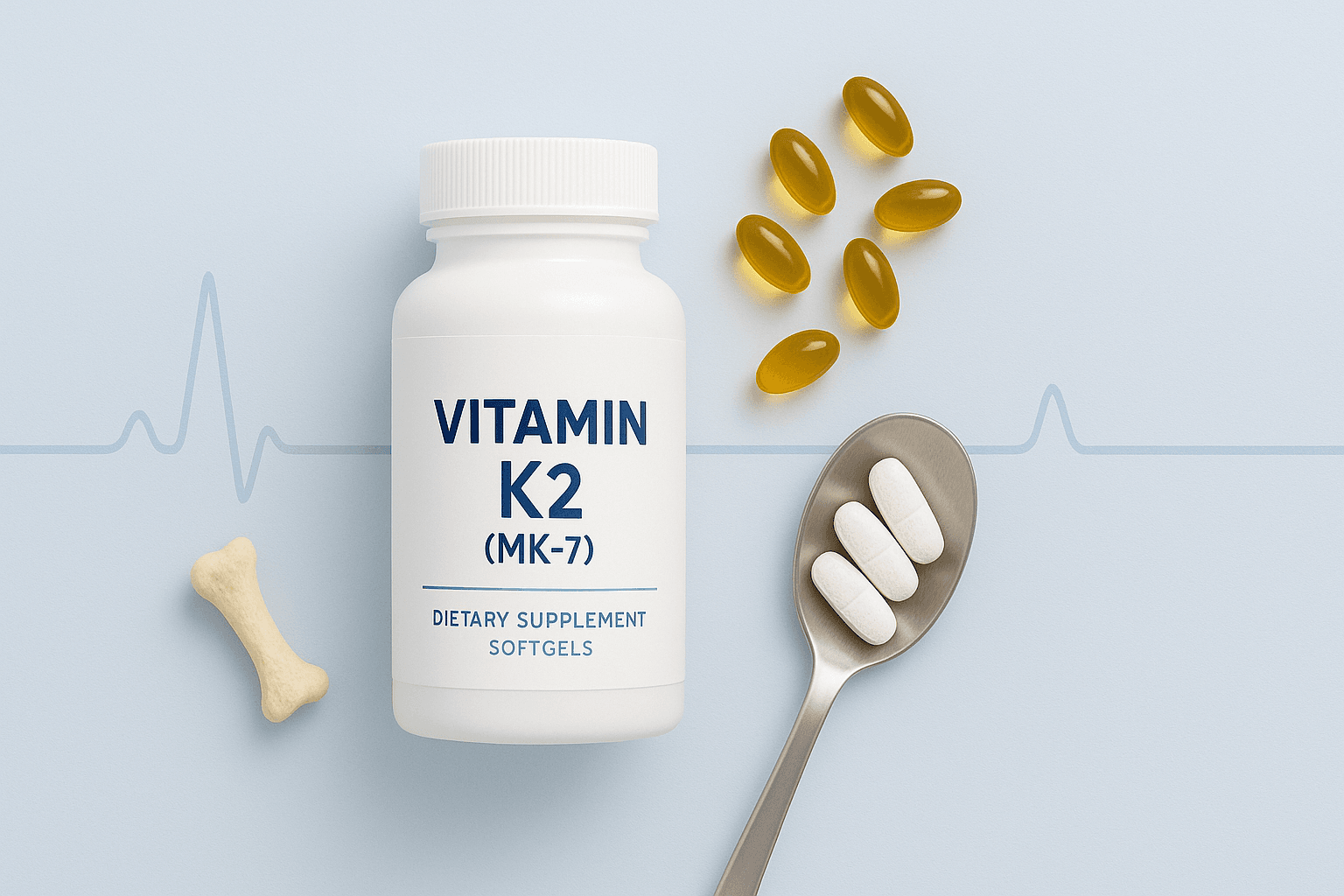
Stronger Bones & Smarter Calcium: Understanding Vitamin K2 (MK-7)
Vitamin K2 (menaquinone-7, or MK-7) is a fat-soluble vitamin typically derived from fermented foods (notably natto) or produced by fermentation of Bacillus species for supplements. Unlike vitamin K1 (phylloquinone), which is concentrated in the liver for blood-clotting factors, MK-7 circulates longer (half-life ≈2–3 days), reaching extrahepatic tissues like bone and blood vessels. There it activates vitamin-K-dependent proteins by γ-carboxylation—most notably osteocalcin in bone and matrix Gla protein (MGP) in vascular tissue. When these proteins are activated, they can bind calcium where you want it (skeleton, teeth) and help keep it out of where you don’t (vessel walls and soft tissues).
Mechanistically, MK-7 serves as a cofactor for the enzyme γ-glutamyl carboxylase, which converts undercarboxylated osteocalcin (uOC) and undercarboxylated MGP (dp-ucMGP) into their active, calcium-binding forms. In practice, this supports bone mineralization, improves “calcium economics,” and is associated with more favorable surrogate markers of arterial health. MK-7 also works synergistically with vitamin D3: D helps you absorb and regulate calcium, while K2 helps direct it.
Wellness takeaway: For bone strength and vascular calcium balance, MK-7 is a practical daily add-on—especially alongside vitamin D3—trial it for 8–12 weeks to shift biomarkers, and reassess at 3–12 months for structural outcomes.
Key Benefits
Bone mineral support: Improves osteocalcin activation and supports bone mineral density and strength over time in adults at risk.
Arterial flexibility: Lowers inactive MGP (dp-ucMGP), a biomarker linked to vascular calcification, supporting healthier vessel elasticity.
Synergy with vitamin D3: Complements D3 by directing absorbed calcium toward bone and away from soft tissues.
Reality check: MK-7 reliably moves biomarkers within weeks; meaningful bone density or arterial changes require months to years and consistent, daily use.
Research Findings
Time to benefit:
Biomarkers (uOC, dp-ucMGP) often improve in 4–12 weeks with daily MK-7. Bone density, microarchitecture, and strength indices typically require 6–36 months. Vascular stiffness measures may shift within 6–12 months when baseline dp-ucMGP is high.
Human trials at a glance (representative):
Postmenopausal bone health (long-term): Daily 180 mcg MK-7 for 3 years supported favorable changes in bone mineral content and strength indices (e.g., at femoral neck and lumbar spine) versus control, alongside marked improvements in osteocalcin carboxylation. Benefits were most pronounced in women with lower baseline K status.
Bone turnover/activation (short-term): 90–180 mcg/day for 8–12 weeks consistently reduces undercarboxylated osteocalcin and improves the cOC:uOC ratio, indicating better calcium utilization in bone formation.
Vascular vitamin K status: Adults with elevated dp-ucMGP taking 180–360 mcg/day for 12–24 weeks show significant declines in dp-ucMGP (i.e., more active MGP), with parallel signals toward improved arterial elasticity in some cohorts, especially when combined with lifestyle changes and vitamin D sufficiency.
Synergy with D3: Trials pairing MK-7 (90–180 mcg/day) with vitamin D3 (1000–4000 IU/day) demonstrate additive improvements in osteocalcin activation and sometimes bone formation markers compared with D3 alone.
Tolerability: MK-7 is generally well tolerated at typical supplemental intakes (90–200 mcg/day). Reported side effects are uncommon and mild (occasional GI upset). The principal safety concern is interaction with vitamin-K-antagonist anticoagulants (e.g., warfarin), where MK-7 can blunt medication effect and destabilize INR.
Best Sources & Dosage
What to buy:
Form: Vitamin K2 as MK-7 (all-trans MK-7 preferred). Look for natural-source, fermentation-derived MK-7 with documented all-trans isomer ≥95% (cis isomers are less bioactive).
Potency & stability: Choose products with microgram-accurate labeling (e.g., 90 mcg, 120 mcg, 180 mcg) and stabilization against oxidation (often delivered in oil-filled softgels or dry microencapsulated powders).
Quality: Third-party testing (USP, NSF, Informed Choice) and a certificate of analysis (COA) confirming identity, potency, and low residual solvents.
Avoid: Blends that underdose MK-7 (e.g., “proprietary K complex” without mcg amounts) or products with high cis-MK-7 content.
Evidence-aligned ranges (by use case):
General bone support in adults: 90–120 mcg MK-7 once daily, with food, for at least 3–6 months; continue long-term if beneficial.
Postmenopausal bone strength focus: 180 mcg MK-7 once daily, with food, for 12–36 months, alongside calcium from diet and vitamin D3 sufficiency.
Vascular calcium balance (biomarker-driven): 180 mcg/day (range 120–360 mcg/day in studies) for 3–12+ months; track dp-ucMGP if available.
With vitamin D3: Ensure 25(OH)D sufficiency (e.g., 30–50 ng/mL); a common pairing is MK-7 90–180 mcg + D3 1000–4000 IU daily, individualized to labs and sun exposure.
Timing & tips:
Take with a meal containing fat to enhance absorption (MK-7 is fat-soluble).
Be consistent daily; MK-7’s long half-life supports steady-state activation of extrahepatic K-dependent proteins.
Stacking: Pair with vitamin D3 and magnesium (a cofactor for vitamin D metabolism); keep calcium primarily food-based (dairy, leafy greens, tofu, bones-in fish).
Self-tracking: Note dental/tendon comfort, training recovery, and—if your clinician orders labs—uOC/cOC or dp-ucMGP at baseline and after 8–12 weeks.
Safety, interactions & exclusions:
Anticoagulants: Do not use MK-7 with warfarin or other vitamin-K antagonists unless your prescriber specifically adjusts and monitors therapy (INR can change quickly).
Other blood thinners: Non-VKA anticoagulants (e.g., DOACs) don’t target vitamin K, but combining supplements with prescription anticoagulation or antiplatelets warrants medical guidance.
Pregnancy/lactation: Usual dietary vitamin K is essential; supplemental MK-7 is likely safe at modest doses, but discuss with your clinician first.
Health conditions: If you have kidney disease, a history of calcium-containing kidney stones, or disorders of mineral metabolism, coordinate with your nephrologist/endocrinologist before adding K2.
Allergies/sensitivities: Fermentation-derived MK-7 rarely triggers reactions; verify excipients if you’re sensitive to soy, sunflower oil, or specific capsule materials.
Upper limits: No established tolerable upper intake level (UL) for MK-7; stick to evidence-aligned microgram doses unless supervised.
Safety flag: Anyone on warfarin (or similar VKAs) should avoid unsupervised MK-7. Medication changes belong with your prescribing clinician.
Dosage Quick-Reference
Bone support (general): 90–120 mcg/day, ≥3–6 months → ↑osteocalcin activation, supportive for BMD over time (↑).
Postmenopausal bone strength: 180 mcg/day, 12–36 months → ↑bone quality indices/BMD trends (↑).
Vascular biomarker focus: 180 mcg/day (± up to 360 mcg/day per clinician), 3–12 months → ↓dp-ucMGP, supportive for arterial elasticity (↑).
Safety note: Take with food and avoid use with vitamin-K-antagonist anticoagulants unless your prescriber is actively managing your dose and monitoring INR.