Understanding Selenium
Selenium is an essential trace mineral that the body requires in very small amounts yet relies on for several fundamental processes. Incorporated into over two dozen proteins known as selenoproteins, selenium plays critical roles in antioxidant defense, thyroid hormone metabolism, immune system activity, and even reproduction. Unlike vitamins such as vitamin D that the body can synthesize under certain conditions, selenium must be obtained exclusively through food or supplementation.
The distribution of selenium in food depends heavily on soil content, which varies widely by region. Populations in parts of Europe, China, and Africa are more likely to have low selenium intake due to poor soil content, while people in North America generally consume adequate amounts because of selenium-rich soils. This uneven distribution makes selenium status highly geographic, influencing both dietary patterns and public health.
Inside the body, selenium is concentrated in the thyroid, liver, kidneys, and skeletal muscle. One of its most important roles is enabling the enzyme glutathione peroxidase, which protects cells from oxidative stress by neutralizing free radicals. This antioxidant activity explains why selenium intake is linked to reduced cellular damage and enhanced immune defense.
Key Benefits
Strengthens antioxidant defenses – Selenium supports enzymes like glutathione peroxidase, which protect tissues from oxidative damage.
Supports thyroid function – Adequate selenium enables proper activation of thyroid hormones critical for energy balance and metabolism.
Promotes immune health – Selenium intake enhances immune cell responsiveness and helps defend against infection.
Research Findings
The health effects of selenium have been studied in a wide range of human trials, from small supplementation studies to large population-based research. Results consistently show benefits when selenium intake is low at baseline, while excessive intake provides no additional advantage and can be harmful.
Immune Function – In a 12-week randomized controlled trial (n=66) of older adults, selenium supplementation improved natural killer cell activity and antibody response compared with placebo. This highlights selenium’s role in bolstering immune defense.
Thyroid Health – In a 6-month RCT (n=169) of individuals with mild autoimmune thyroid concerns, selenium supplementation reduced thyroid antibody levels compared with placebo, suggesting a role in thyroid balance.
Oxidative Stress – In a 40-week cohort study (n=501) of adults at risk for chronic disease, selenium supplementation improved blood antioxidant capacity and lowered markers of oxidative stress, particularly in individuals with low baseline selenium.
Chronic Disease Risk – Large-scale observational research, such as the EPIC cohort study (n>13,000), found that higher selenium status correlated with reduced risk of certain cancers and cardiovascular events. However, intervention trials show mixed results, underscoring the importance of balanced—not excessive—intake.
Together, these studies confirm selenium’s importance for immune regulation, thyroid hormone balance, and oxidative stress defense, while emphasizing that its benefits are most pronounced in populations with insufficient intake.
Best Sources & Dosage
Selenium is widely available in food, though content depends strongly on soil quality. Both plant and animal foods contribute, with some sources being exceptionally rich.
Food sources:
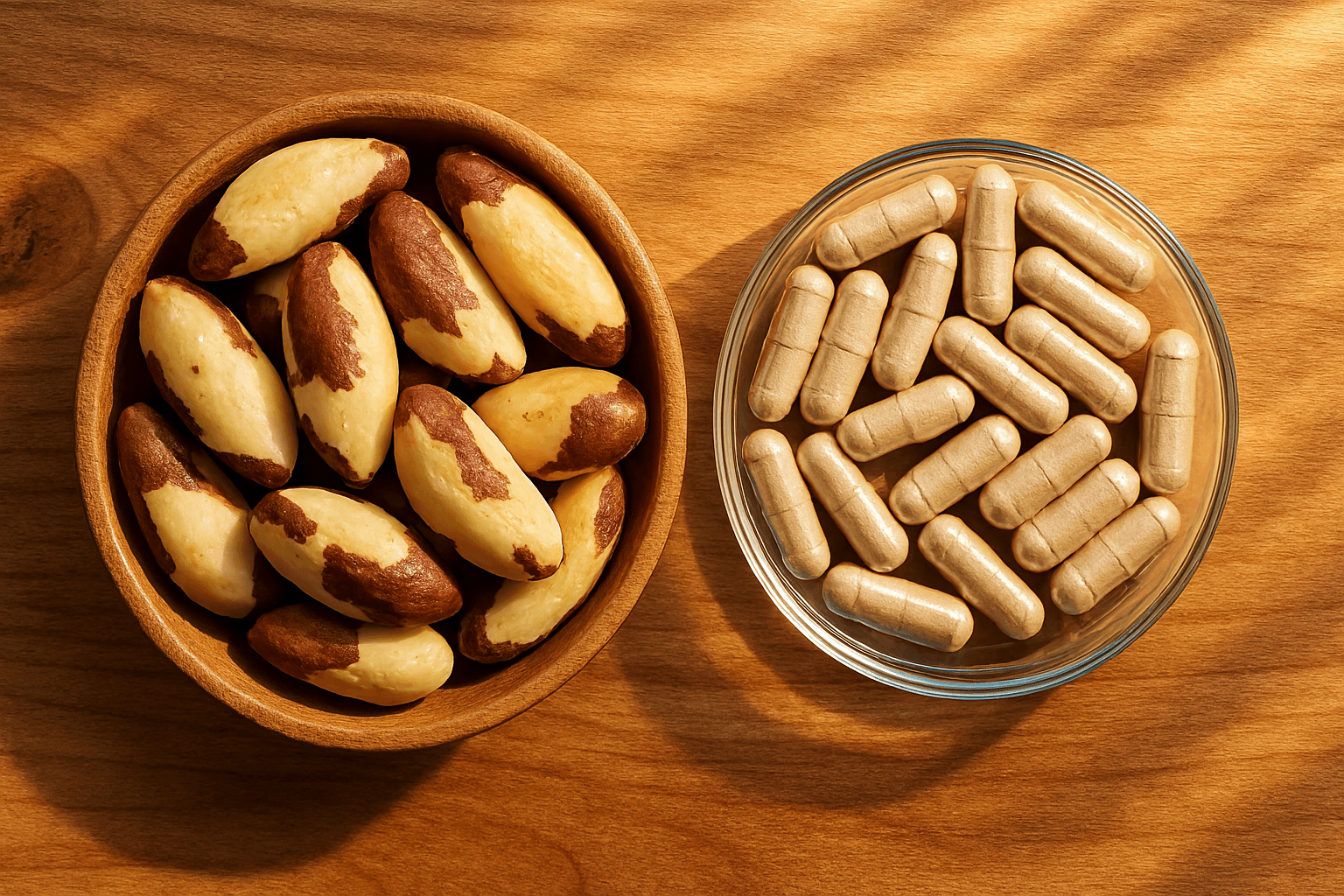
- Brazil nuts – the richest source, with a single nut providing 50–90 mcg.
- Seafood – tuna, sardines, and shrimp are reliable sources.
- Meats and poultry – beef, turkey, and chicken contain moderate amounts.
- Eggs and dairy – steady contributors to daily intake.
- Grains and seeds – content varies depending on soil selenium.
Supplemental forms:
- Selenomethionine – an organic form, well-absorbed, often the preferred option.
- Sodium selenite/selenate – inorganic forms, also effective though slightly less bioavailable.
Dosage:
The recommended daily allowance (RDA) for adults is 55 mcg/day. Clinical studies often use 100–200 mcg/day, particularly in populations with low baseline intake. Intakes above 400 mcg/day are not recommended, as this is the upper safe limit established to prevent toxicity.
Timing and safety:
Selenium supplements can be taken with or without food. Because selenium is stored in the body, daily intakes above safe levels can lead to selenosis, a condition marked by nausea, fatigue, hair loss, and nail brittleness. For most healthy adults, adequate selenium can be achieved through diet without requiring high-dose supplementation.
Traditional and Public Health Context
Unlike herbs or botanicals with cultural histories, selenium’s relevance comes mainly from public health and nutrition science. Regions of the world with selenium-deficient soil have historically faced health issues linked to deficiency, including Keshan disease (a cardiomyopathy observed in parts of China) and Kashin-Beck disease (a joint and bone disorder). These conditions dramatically improved when selenium intake was corrected, highlighting the mineral’s essential role in human health.
Today, selenium continues to be studied in the context of chronic disease prevention. Its role in cancer prevention has been explored extensively, with some evidence of protective associations, though intervention results are mixed. Similarly, research into selenium and cardiovascular health suggests benefit for those with low intake, but not in populations with adequate status.
Scientific Gaps and Future Directions
While the essential role of selenium in antioxidant defense and thyroid health is well-established, questions remain about its broader role in chronic disease prevention. Large randomized trials show conflicting outcomes on cancer and cardiovascular risk, suggesting benefits depend heavily on baseline selenium status and population differences.
Future research is expected to focus on:
- Precision nutrition approaches that account for genetic differences in selenium metabolism.
- Comparative trials of selenium forms (selenomethionine vs. sodium selenite) for bioavailability and effectiveness.
- Long-term studies in selenium-deficient populations to better define safe and effective supplementation ranges.
The central message is that selenium is most beneficial when correcting low intake—not when consumed in excess.