
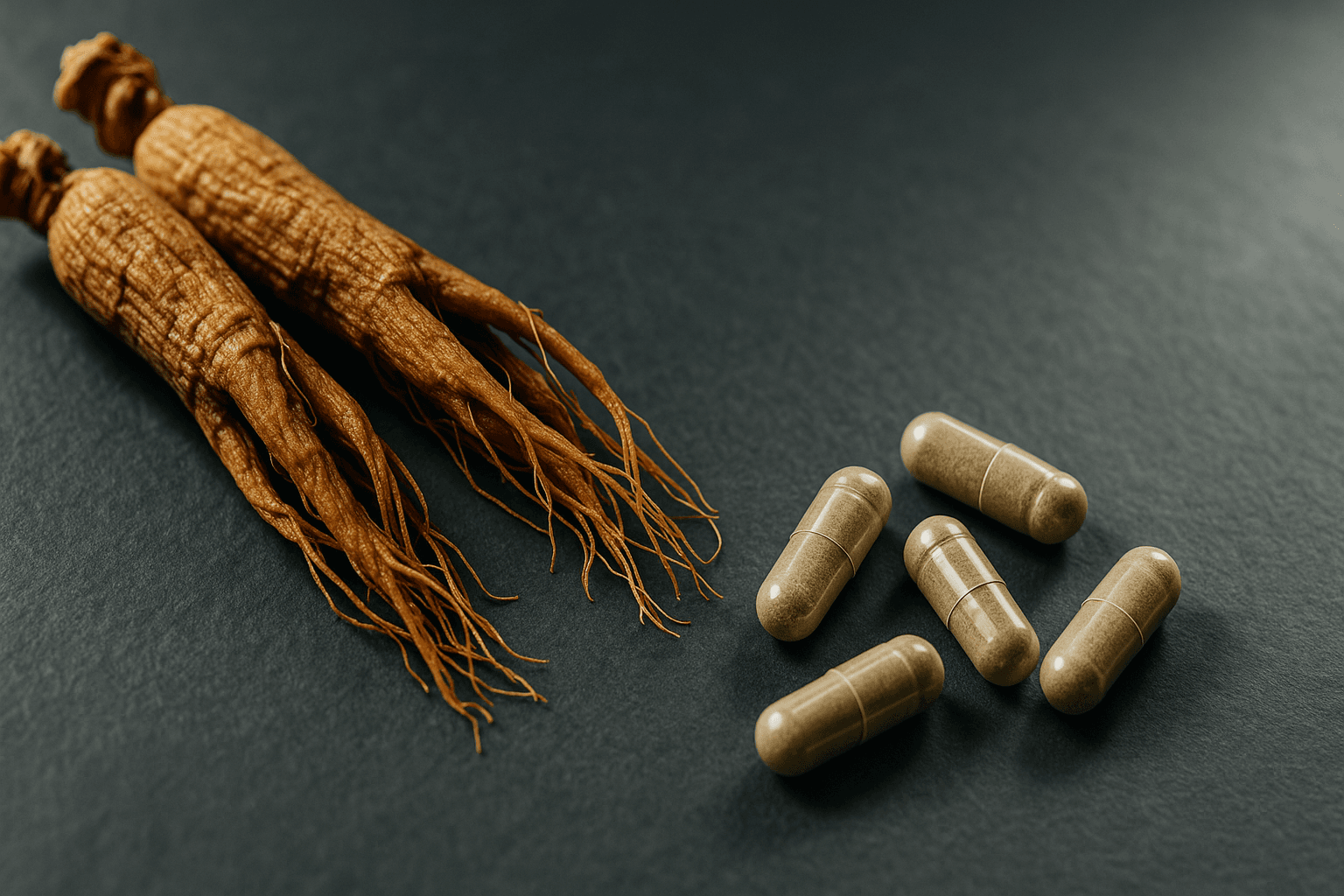
Understanding Panax ginseng
Panax ginseng (Asian ginseng; Panax ginseng C.A. Meyer) is a slow-growing root used for centuries in East Asian medicine as a general tonic and “adaptogen.” Modern supplements concentrate bioactive saponins called ginsenosides (e.g., Rb1, Rb2, Rc, Rd, Re, Rg1, Rg3), along with gintonin and polysaccharides. These compounds appear to influence several systems relevant to energy, cognition, and metabolic health: modulation of the hypothalamic–pituitary–adrenal (HPA) stress axis; nitric-oxide–mediated vasodilation; antioxidant and anti-inflammatory signaling; and effects on glucose handling through insulin sensitivity and secretion pathways.
You’ll see Panax ginseng sold in a few common preparations:
- White ginseng — air-dried root.
- Korean Red Ginseng (KRG) — steamed/aged root that transforms its ginsenoside profile (notably increasing Rg3, Rg5, and Rh1).
- Standardized extracts — often labeled by total ginsenosides (e.g., 3–7%) or by a proprietary name (e.g., G115®, HRG80®, ThinkGIN™).
- Berry or sprout extracts — newer forms with distinct ginsenoside ratios (often relatively higher in Re/Rg1) studied for cognition and glycemia.
Diet alone doesn’t deliver clinically meaningful ginsenoside doses—ginseng isn’t a routine food, and teas/decoctions vary widely. Standardized capsules offer predictable dosing and are used in clinical trials, which is why supplementation is the practical route when you’re targeting specific outcomes like fatigue, cognitive support, or glucose control.
Key Benefits
Cognitive support in age-related memory complaints. Standardized Panax ginseng sprout extract (450 mg/day) improved memory test performance and sleep quality over 12 weeks in older adults with subjective memory impairment compared with placebo.
Fatigue management during chemotherapy. In a large phase III trial in colorectal cancer patients on FOLFOX, 2 g/day Korean Red Ginseng reduced cancer-related fatigue domain scores versus placebo, with greater benefits in predefined subgroups (e.g., ≥60 years, women, higher baseline fatigue).
Glycemic support in higher-risk individuals. A 12-week randomized trial found ginseng berry extract (1 g/day) lowered fasting and post-challenge glucose in participants whose fasting glucose was ≥110 mg/dL (prediabetic range), versus no change on placebo; effects were not seen in the full mixed cohort.
Reality check: For erectile dysfunction, a 2022 systematic review found only trivial improvements on validated scores versus placebo across short trials; benefits may not be clinically meaningful for many men.
Research Findings
Cognition (subjective memory impairment): 12-week, randomized, double-blind trial in 80 adults aged 55–75 taking Panax ginseng sprout extract 450 mg/day vs placebo improved verbal/visual memory (SVLT, RCFT), global cognition (MoCA-K), and sleep quality (PSQI-K), with no safety signals.
Cancer-related fatigue (colorectal cancer on chemotherapy): 16-week, multicenter, phase III, randomized, double-blind trial (n=438) using Korean Red Ginseng 2,000 mg/day vs placebo showed greater reductions in Brief Fatigue Inventory area-under-the-curve (notably “Mood,” “Walking ability” domains) and global fatigue in per-protocol analyses; neutropenia occurred more often with KRG, while overall adverse events were similar.
Glycemia (prediabetes subgroup): 12-week, randomized, double-blind trial (n=72; 1 g/day Panax ginseng berry extract) showed significant reductions in fasting glucose (
3.7%) and OGTT 60-min glucose (10.7%) only in participants with baseline fasting glucose ≥110 mg/dL; no HbA1c change and no overall effect in the entire cohort.Erectile function (overall evidence): A 2022 systematic review (9 RCTs; ≤12 weeks; 587 men) reported low-certainty and trivial mean improvements on IIEF-15 erectile function domain vs placebo (MD ≈ 3.5 on a 30-point scale), suggesting limited clinical impact.
Best Sources & Dosage
Forms you’ll see:
Standardized root extracts (typically 3–7% ginsenosides): capsules or tablets.
Korean Red Ginseng (KRG) powders/extracts: often dosed in grams/day.
Specialized extracts (e.g., sprout or berry): labeled per-day mg with proprietary names.
Evidence-based ranges (adults):
General vitality or cognitive support: 200–400 mg/day of a standardized root extract, taken in the morning (and early afternoon if split), for 8–12 weeks; avoid evening dosing if prone to insomnia. (Range aligned to common clinical protocols; specific cognition RCT used 450 mg/day of sprout extract.)
Cancer-related fatigue (adjunct to chemo): KRG 2,000 mg/day divided doses for 16 weeks under oncology supervision.
Prediabetes-range hyperglycemia: Ginseng berry extract 1,000 mg/day for 12 weeks showed benefit only when fasting glucose ≥110 mg/dL; not a substitute for diet/exercise or prescribed therapy.
Timing & cycling: Take with breakfast (and lunch if split). Because ginseng can be mildly stimulating, avoid late-day doses. Many practitioners use 8–12-week cycles with 2–4-week breaks to reassess need.
Safety, interactions & who should avoid it:
Generally well tolerated in trials up to 16 weeks; reported effects include insomnia, nervousness, GI upset, and rare headache—often dose-related.
Anticoagulants/antiplatelets (e.g., warfarin): case reports suggest altered anticoagulant effect—use only with clinician oversight.
Diabetes medications: potential additive glucose-lowering; monitor for hypoglycemia if you’re on insulin or secretagogues.
Autoimmune conditions or hormone-sensitive cancers: theoretical immunomodulatory/estrogenic concerns—discuss with your specialist.
Pregnancy/lactation: insufficient safety data—avoid unless advised by your clinician.
Surgery: stop 1–2 weeks prior due to bleeding/glucose concerns.
Label literacy tip: choose products that standardize ginsenosides and disclose the extract ratio (e.g., 10:1) and daily ginsenoside amount.
Dosage Quick-Reference
Cognitive support (SMI): 450 mg/day sprout extract • 12 weeks • Outcome: memory & sleep ↑ vs placebo.
Cancer-related fatigue (CRC on FOLFOX): 2,000 mg/day KRG • 16 weeks • Outcome: fatigue domains ↑; per-protocol global fatigue ↑.
Prediabetes-range fasting glucose ≥110 mg/dL: 1,000 mg/day ginseng berry extract • 12 weeks • Outcome: fasting & OGTT 60-min glucose ↓; HbA1c →.
Erectile dysfunction (general): various formulations ≤12 weeks • Outcome: small/trivial IIEF improvement vs placebo → (low-certainty).