
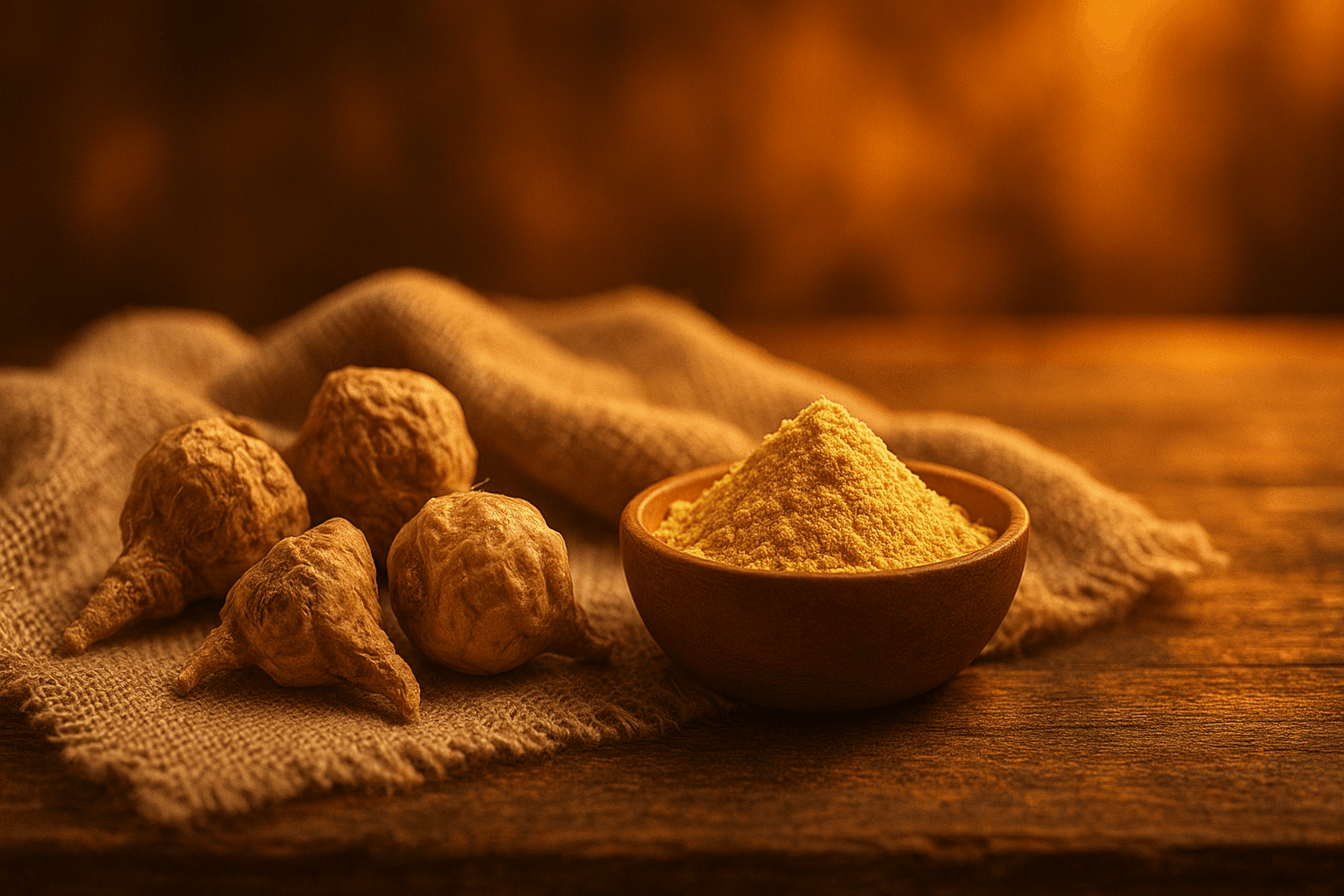
Understanding Maca Root
Maca (Lepidium meyenii) is a hardy cruciferous plant that thrives in the high-altitude regions of the Peruvian Andes, where it has been cultivated for more than 2,000 years. Its root is the edible portion and has historically been consumed as food and medicine by indigenous communities for stamina, fertility, and overall vitality. Today, maca is recognized globally as a functional superfood and supplement.
Nutritionally, maca root is rich in carbohydrates, fiber, amino acids, and essential minerals like iron, copper, and calcium. Beyond these nutrients, maca contains distinctive bioactive compounds such as macamides, macaenes, glucosinolates, and polyphenols, which contribute to its physiological activity. These compounds have been linked to improved energy balance, mood regulation, and reproductive health.
Maca is not an essential nutrient, meaning the body does not require it for survival in the same way it requires vitamins and minerals. Instead, it functions as a botanical adaptogen—helping the body adapt to stressors and supporting endocrine and nervous system pathways. Different varieties of maca exist—yellow, red, and black—each with slightly distinct compound profiles and potential benefits. For instance, red maca has been studied in relation to prostate health, while black maca has shown promising effects on memory and sperm parameters.
Key Benefits
Enhances energy and stamina – Human studies document improvements in perceived energy, endurance, and reduced fatigue.
Supports mood and well-being – Trials demonstrate reductions in anxiety, depressive symptoms, and improved quality of life scores.
Promotes sexual and reproductive health – Research shows improvements in libido, sperm quality, and hormonal balance.
Research Findings
Scientific studies on maca root are relatively recent but steadily growing. Most are randomized controlled trials in small to medium-sized populations, providing promising evidence for several health domains.
Energy and Stamina – In a 12-week randomized controlled trial (n=175) of healthy men and women, daily maca supplementation increased perceived energy levels and reduced fatigue compared with placebo. The participants also reported enhanced endurance during exercise testing.
Mood Support – In a 12-week double-blind trial (n=29) involving postmenopausal women, maca supplementation improved scores on standardized mood scales, with reductions in anxiety and depressive symptoms versus placebo. The effect was not accompanied by changes in estrogen levels, suggesting a non-hormonal mechanism of action.
Reproductive Health in Men – In a 16-week RCT (n=50) of healthy men, maca supplementation improved semen volume, sperm motility, and sexual desire compared with placebo. Importantly, hormone levels such as testosterone and estradiol remained stable, indicating benefits independent of hormone changes.
Bone and Prostate Health – A study of red maca in middle-aged men (n=56) found reductions in prostate size over 12 weeks, while animal data suggest potential support for bone density, though human evidence remains limited.
These findings support maca’s role as a functional food with targeted benefits for energy, mood, and reproductive health, while also hinting at broader applications that require further study.
Best Sources & Dosage
Maca root is consumed in several forms, each offering slightly different advantages depending on individual preference and digestive tolerance.
Forms:
- Raw powdered maca – traditional form, added to smoothies, oatmeal, or baked goods.
- Gelatinized maca – pre-heated to remove starch, easier to digest, commonly used in supplements.
- Extracts and capsules – standardized forms offering consistent active compound content.
Dosage:
Human studies generally use 1.5 to 3 grams per day of dried maca powder or equivalent extract. Some clinical trials have tested up to 5 grams daily without significant safety issues. Doses are usually divided across one or two servings.
Timing:
Maca can be taken with or without food. Many users prefer morning or early-afternoon intake due to its energizing properties.
Safety Considerations:
Maca has a long history of dietary use and is considered safe in studied amounts. Reported side effects are rare and typically limited to mild digestive discomfort. Because of its influence on reproductive health, individuals with hormone-sensitive conditions or those who are pregnant or breastfeeding should consult a healthcare provider before use.
Traditional and Cultural Context
For indigenous Andean populations, maca is more than a supplement—it is a staple food and cultural symbol. Families traditionally boil, roast, or ferment the root, and it is incorporated into porridges, breads, and beverages. Maca was historically valued not only for daily nourishment but also for its role in fertility and resilience at high altitude. Its enduring cultural significance continues today, with Peru protecting maca as a national heritage crop.
Scientific Gaps and Future Directions
Although clinical research on maca is promising, several gaps remain. Many studies are limited by small sample sizes, short durations, and reliance on subjective measures. More large-scale, long-term trials are needed to clarify its effects on physical performance, cognitive function, and specific hormonal pathways. Additionally, research comparing different maca varieties (yellow, red, black) will help refine understanding of their unique benefits.