
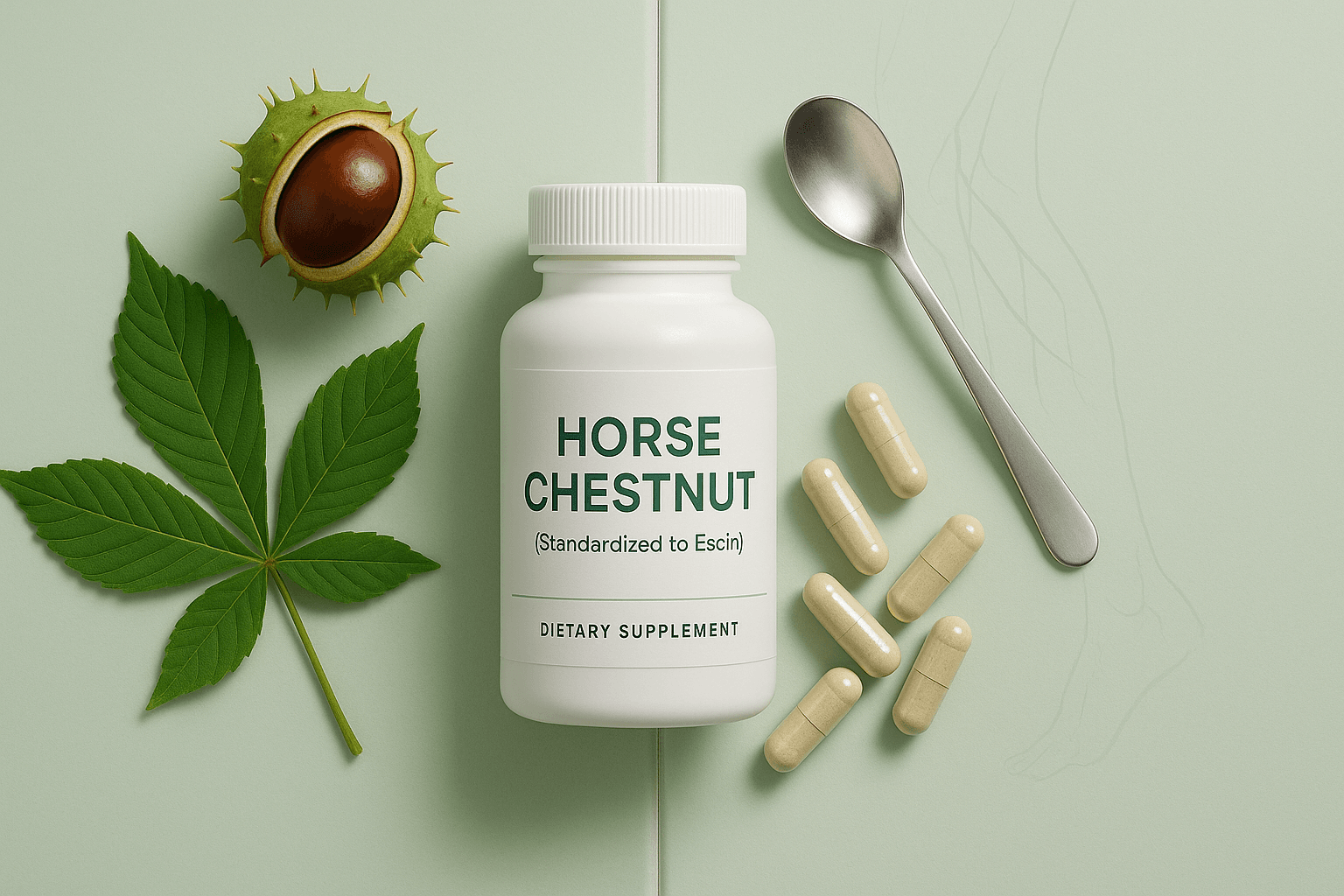
Lighter legs & healthier veins: Understanding Horse Chestnut (Aesculus hippocastanum)
Horse chestnut extract (HCE) is a standardized herbal preparation from the seeds of the horse chestnut tree. Modern products are typically standardized to aescin/escin (a mixture of triterpene saponins) at ~16–20%. Aescin is thought to support venous tone and microcirculatory integrity by reducing capillary permeability, inhibiting inflammatory mediators, and improving lymphatic drainage. In everyday terms, it helps veins work “snappier” and leak less fluid into surrounding tissues—translating to less swelling, heaviness, and aching in the legs, especially for people with chronic venous insufficiency (CVI), varicose veins, or long days on their feet.
Mechanistically, aescin appears to: (1) tighten endothelial junctions to reduce edema, (2) exert mild venotonic effects that improve venous return, and (3) provide anti-inflammatory/antioxidant actions that may lessen discomfort after prolonged standing or travel. HCE is often discussed alongside compression therapy and movement—two fundamentals for venous health.
Wellness takeaway: A quality, aescin-standardized horse chestnut can be a practical adjunct for leg swelling and venous comfort. Pair with compression, walking breaks, and calf raises. Trial 8–12 weeks, then reassess.
Key Benefits
Venous tone & comfort: Supports leg vein function and reduces sensations of heaviness, aching, and fatigue in adults with CVI.
Ankle and calf swelling: Clinically reduces lower-leg edema and ankle circumference over weeks of consistent use.
Everyday performance: Helps legs feel lighter during prolonged standing, sitting, or travel; complements (not replaces) compression therapy.
Reality check: Benefits are meaningful but moderate; they rely on daily dosing plus basics (compression, movement, weight management). It’s not a cure for varicose veins.
Research Findings
Time to benefit: Many users notice lighter legs and less evening swelling within 2–4 weeks; edema and symptom scores typically continue to improve across 8–12 weeks. For stubborn CVI, evaluate after 3 months, then consider maintenance.
Representative human studies (summarized):
CVI symptom relief: Randomized, placebo-controlled trials using aescin 100–150 mg/day (from standardized seed extract) for 8–12 weeks show reductions in leg pain/heaviness and improved global assessments by patients and clinicians. Effect sizes are comparable to wearing compression stockings in some cohorts, especially for edema reduction.
Edema/ankle circumference: Multiple trials report statistically significant decreases in lower-leg volume and ankle circumference versus placebo after 6–8 weeks of treatment, aligning with subjective relief of tight shoes/socks at day’s end.
Functional improvement & quality of life: In observational programs (6–12 weeks), participants report improved walking comfort and reduced night cramping, with good tolerability; benefits tend to plateau with continued use unless lifestyle factors improve in parallel.
Post-operative/trauma swelling (adjunct): Short-term studies using oral and/or topical escin suggest faster reduction of edema and bruising post-injury or after surgery; these are adjunctive signals and should follow clinician guidance.
Tolerability: Standardized HCE is generally well tolerated. Reported side effects are usually mild and transient (GI upset, nausea, pruritus, dizziness, headache). Serious adverse events are uncommon when using purified, esculin-removed extracts at labeled doses.
Best Sources & Dosage
What to buy:
Standardized extract: Look for horse chestnut seed extract standardized to escin ~16–20%. Products often indicate the escin content per capsule (e.g., 50 mg escin).
Purity matters: Raw seeds/leaves/flowers contain esculin, which is toxic; reputable supplements are processed to remove esculin and meet contaminant limits. Choose brands with COA and third-party testing (USP/NSF/Informed Choice).
Form & format: Capsules or tablets are most common. Topical escin gels/creams can be used adjunctively for bruises or local swelling but are not substitutes for oral dosing in CVI.
Evidence-aligned ranges (by use case):
Chronic venous insufficiency / varicose-related symptoms:
Escin 100–150 mg/day, typically divided 50 mg escin twice daily, with food, for 8–12 weeks, then continue if helpful.
Alternatively expressed as 300–600 mg HCE/day if standardized to ~16–20% escin (check label for actual escin mg).
Edema with prolonged standing/sitting or travel (adjunct):
- Escin 50–100 mg/day starting 1–2 weeks before a known high-load period (e.g., seasonal retail shift, long-haul flights) and continue through the exposure; pair with movement breaks and compression.
Hemorrhoids (short-term adjunct):
- Escin 100 mg/day for 2–4 weeks alongside fiber, fluids, and stool-softening strategies; seek clinician care for bleeding or persistent pain.
Timing & tips:
Take with meals to minimize GI upset.
Combine with graduated compression stockings, walking breaks (2–3 min every 30–60 min), calf raises, and ankle pumps—synergy matters.
Track: evening ankle circumference (measuring tape), leg heaviness (0–10), and number of rest breaks needed per day.
Safety, interactions & exclusions:
Raw plant parts are unsafe: Do not ingest raw seeds, bark, leaves, or homemade preparations (esculin toxicity risk). Use only purified, standardized extracts.
GI & skin reactions: Mild nausea, stomach upset, itching, or rash can occur; stop if persistent.
Anticoagulants/antiplatelets: Use caution and professional oversight if you take warfarin, DOACs, aspirin, clopidogrel, or high-dose omega-3s; monitor for bruising/bleeding.
Kidney or liver disease: Escin has been associated with renal stress in high doses/IV forms; if you have renal or hepatic impairment, avoid or use only under clinician supervision.
Diabetes & blood pressure meds: Limited data suggest escin might influence vascular tone and glycemic responses; monitor if you’re on antihypertensives or antihyperglycemics.
Pregnancy/lactation: Insufficient data—avoid unless your clinician recommends and monitors.
Allergies: Rare hypersensitivity reactions; discontinue with swelling or breathing difficulty.
Safety flag: Avoid all non-standardized or homemade horse chestnut products. Choose only COA-verified, esculin-free extracts.
Dosage Quick-Reference
CVI/varicose symptoms: Escin 50 mg BID (≈100 mg/day), 8–12 wks → ↓leg heaviness/aching, ↓ankle circumference (↑comfort).
Standing/sitting edema (adjunct): Escin 50–100 mg/day, during high-load weeks → ↓evening swelling (↑stamina).
Hemorrhoids (adjunct): Escin 100 mg/day, 2–4 wks → ↓pain/edema (→symptomatic relief; seek care for bleeding).
Safety note: Use only standardized, esculin-removed extracts; review meds for bleeding risk; avoid in pregnancy and significant kidney/liver disease.