
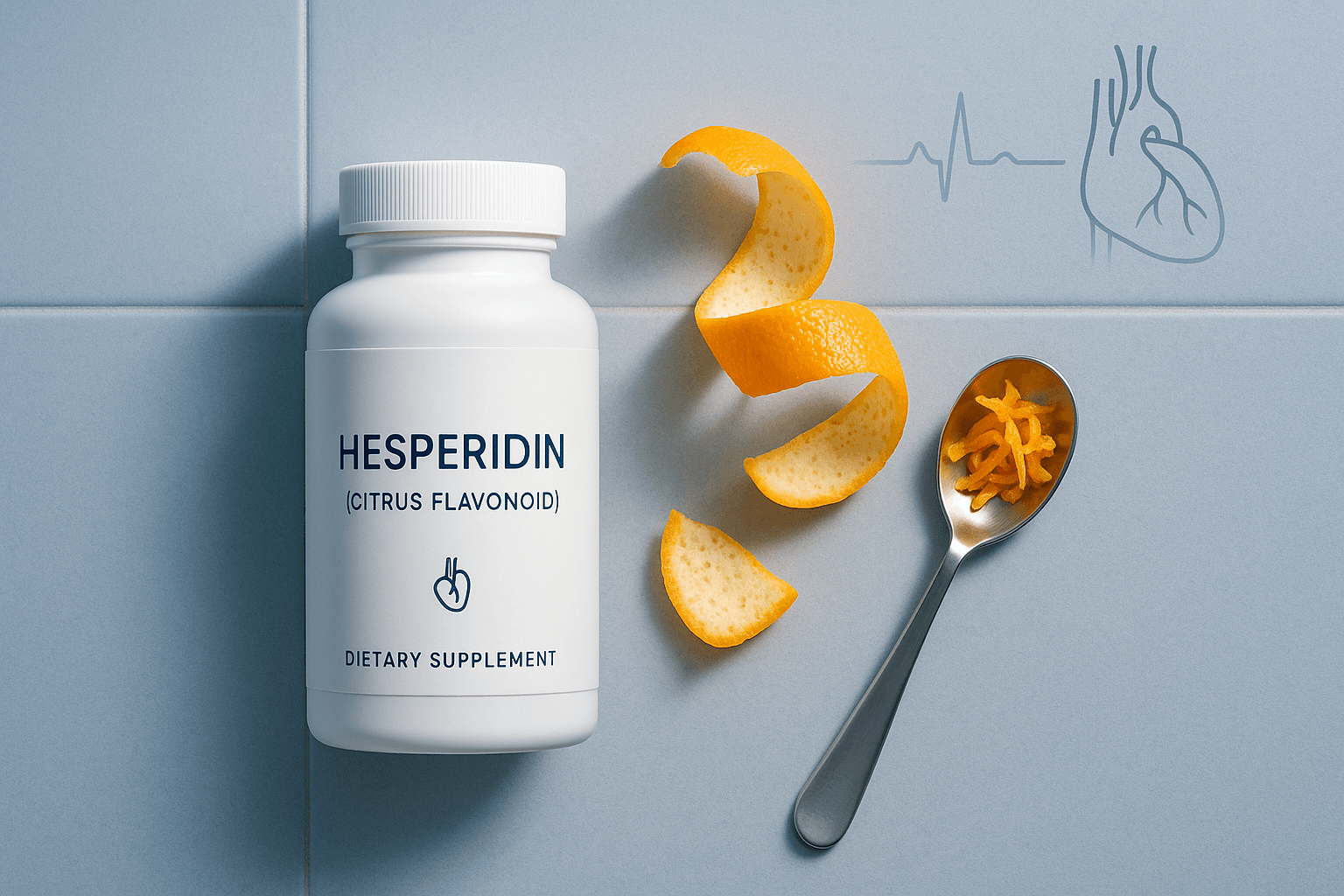
Smoother Circulation, Calmer Vessels: Understanding Hesperidin
Hesperidin is a citrus bioflavonoid concentrated in orange and lemon peels and the white pith. In the body it’s metabolized to hesperetin, which influences endothelial function (how well blood vessels dilate), nitric oxide signaling, and inflammatory tone. You’ll see it sold as standalone hesperidin, as hesperidin methyl chalcone (HMC)—a more water-soluble variant used in vein/lymph support—or paired with related flavonoids (e.g., diosmin in “micronized purified flavonoid fraction,” MPFF). At wellness doses, people use hesperidin to support healthy blood pressure, microcirculation (capillary strength), and venous comfort in the legs.
Food helps—citrus, especially zest and pith, delivers natural hesperidin—but typical diets rarely reach the amounts tested in human trials. Standardized capsules or HMC formulas provide predictable, study-like dosing without relying on daily citrus prep (and without the sugar of juice).
How hesperidin may help—kept practical:
Endothelial “ease”: increases flow-mediated dilation and nitric oxide bioavailability, translating to more elastic arteries and a nudge toward healthier blood pressure.
Microcirculation support: stabilizes capillary integrity (less leakage/fragility) and modulates inflammatory mediators relevant to leg heaviness, swelling, and hemorrhoidal discomfort.
Metabolic tidy-up: antioxidant and AMPK-adjacent signals can support post-meal vascular calm and a favorable milieu for lipids and glucose (modest effects).
Wellness takeaway: If your goals are friendlier BP, better leg comfort, and steadier vascular tone, a standardized hesperidin or HMC supplement can round out fiber-forward meals, daily walks, and sleep regularity.
Key Benefits
Blood pressure & endothelial function. Consistent hesperidin use modestly improves flow-mediated dilation and can lower systolic BP a few mmHg, especially in people starting higher.
Leg vein comfort & capillary strength. Hesperidin (often as HMC or paired with diosmin) supports venous tone and micro-leakage control, easing sensations of heaviness and swelling in the calves/ankles.
Hemorrhoid symptom relief (adjunct). In short courses, citrus bioflavonoids help reduce pain, bleeding, and edema during flares—best as part of a fiber/hydration routine.
Reality check: Expect steady, incremental changes on the meter (BP) and in day-to-day comfort across 4–12 weeks—not a drug-like drop. Keep lifestyle foundations in place.
Research Findings
Time to benefit: First vascular changes may appear by 2–4 weeks, with clearer BP/comfort gains by 8–12 weeks of consistent dosing.
Endothelial function & BP (adults with elevated BP or at risk): In 6–12-week, randomized, double-blind trials (n≈80–160), hesperidin 500–1000 mg/day or hesperidin-rich citrus extracts improved flow-mediated dilation and produced small systolic BP reductions (~2–5 mmHg) versus placebo.
Venous insufficiency/leg symptoms: 8–12 weeks, randomized designs (n≈60–120) using HMC 500 mg 2–3×/day or MPFF (diosmin/hesperidin, typically 1000 mg/day) reported reduced leg heaviness, cramps, and ankle circumference vs placebo or usual care.
Hemorrhoids (acute flares): 7–14-day, randomized courses (n≈60–100) of citrus bioflavonoids (often HMC ± vitamin C) yielded faster relief of pain, bleeding, and edema compared with controls; effects were additive to fiber and sitz baths.
Tolerability across trials was favorable. The most common effects were mild GI upset, headache, or flushing, usually transient and dose-related.
Best Sources & Dosage
What to buy (and what to avoid)
Choose hesperidin or hesperidin methyl chalcone (HMC) with mg per serving clearly stated and third-party testing.
For leg-vein programs, HMC or a diosmin/hesperidin blend (MPFF) is commonly used in clinical settings; for general vascular/BP goals, standalone hesperidin 500–1000 mg/day is typical.
Avoid proprietary blends without disclosed milligrams—you can’t match research-style dosing or titrate response without numbers.
Evidence-aligned adult ranges
Blood pressure & endothelial function (primary): 500–1000 mg/day hesperidin, once daily or split BID, with meals, for 8–12 weeks, then reassess BP and, if available, pulse-wave or FMD metrics.
Leg vein comfort / microcirculation: HMC 500 mg, 2–3×/day with meals for 8–12 weeks; or MPFF 1000 mg/day (follows many vein-care protocols).
Hemorrhoid flare (adjunct): HMC 500 mg 2–3×/day for 7–14 days, alongside fiber (25–35 g/day), hydration, and sitz baths; taper when symptoms resolve.
Timing & tips
Take with meals to reduce GI upset.
For BP goals, pair with daily walks (10–15 min after meals), DASH-style meals, and sleep regularity—they compound the effect.
For legs: elevate when practical, use graduated compression on long standing days, and log ankle circumference (same time of day) weekly.
Safety, interactions & who should avoid it
Generally well tolerated. Occasional GI upset, headache, or flushing can occur—lower the dose or split it.
Medications: hesperidin/HMC may have mild antiplatelet effects; use caution with anticoagulants/antiplatelets and coordinate with your clinician before stacking.
Blood pressure meds: additive BP-lowering is possible—monitor to avoid lightheadedness.
Allergy: citrus sensitivities are rare but possible; discontinue if rash or itching develops.
Pregnancy/lactation: limited targeted data—avoid routine supplemental dosing unless advised by your clinician.
Surgery: consider pausing 1–2 weeks prior due to theoretical bleeding risk.
Label literacy—fast checks
- “Hesperidin” or “Hesperidin methyl chalcone” named explicitly, mg per serving clear.
- For vein programs, look for HMC 500 mg per cap or MPFF 1000 mg/day equivalents.
- Third-party testing/COA; realistic capsule count for an 8–12-week plan.
Dosage Quick-Reference
BP & endothelial support: 500–1000 mg/day hesperidin • With meals, 8–12 weeks • Outcome: systolic BP ↓ (modest), vessel flexibility ↑.
Leg vein comfort: HMC 500 mg 2–3×/day (or MPFF 1000 mg/day) • 8–12 weeks • Outcome: heaviness/swelling ↓, walking comfort ↑.
Hemorrhoid flare (adjunct): HMC 500 mg 2–3×/day • 7–14 days • Outcome: pain/bleeding/edema ↓ (with fiber + sitz).
Safety note: coordinate if on anticoagulants/antiplatelets; monitor BP when combined with antihypertensives.